Opera
Kyz - Zhibek April 25, 2026, 18:00
Description
A lyrical epic opera about love, loyalty, and a tragic fate, where the beauty of Kazakh musical heritage is revealed in heartfelt music and a poetic plot. The story of Kyz Zhibek and Tulegen is imbued with deep emotion, national flavor, and an emotional power that makes this production truly memorable.
“Whatever music I created, it turned back to be Kazakh…”, – this is how the composer Yevgeny Grigorievich Brusilovsky said. His work, inextricably linked with the development of Kazakh national opera art and musical culture, evokes a genuine sense of admiration. The music of the opera “Kyz-Zhibek” is entirely based on folklore material. It includes more than fifty kyuis and songs, which are among the finest examples of folk music and poetry.
To shape the characters, the composer used vocal and instrumental music of different themes, genres and moods, organically reflecting the inner essence of each figure. Thus, the main heroine Zhibek has her own circle of songs that outlines her various psychological states. These are the ecstatic and jubilant “Gakku”, the tender “Tolkyma”, the tragic “Dunie-ai”, and the resolute “Raushan”, written by folk composers Ybyray Sandybaev, Aitbai Gabbasov, Mukhit Meraliev and others. As musical characteristics of Tulegen, the songs “Kos baraban”, “Alkaray kok” and “Karakoz” are used, emphasizing the hero’s nobility, his longing for happiness, and his unwillingness to remain confined within the framework of tradition.
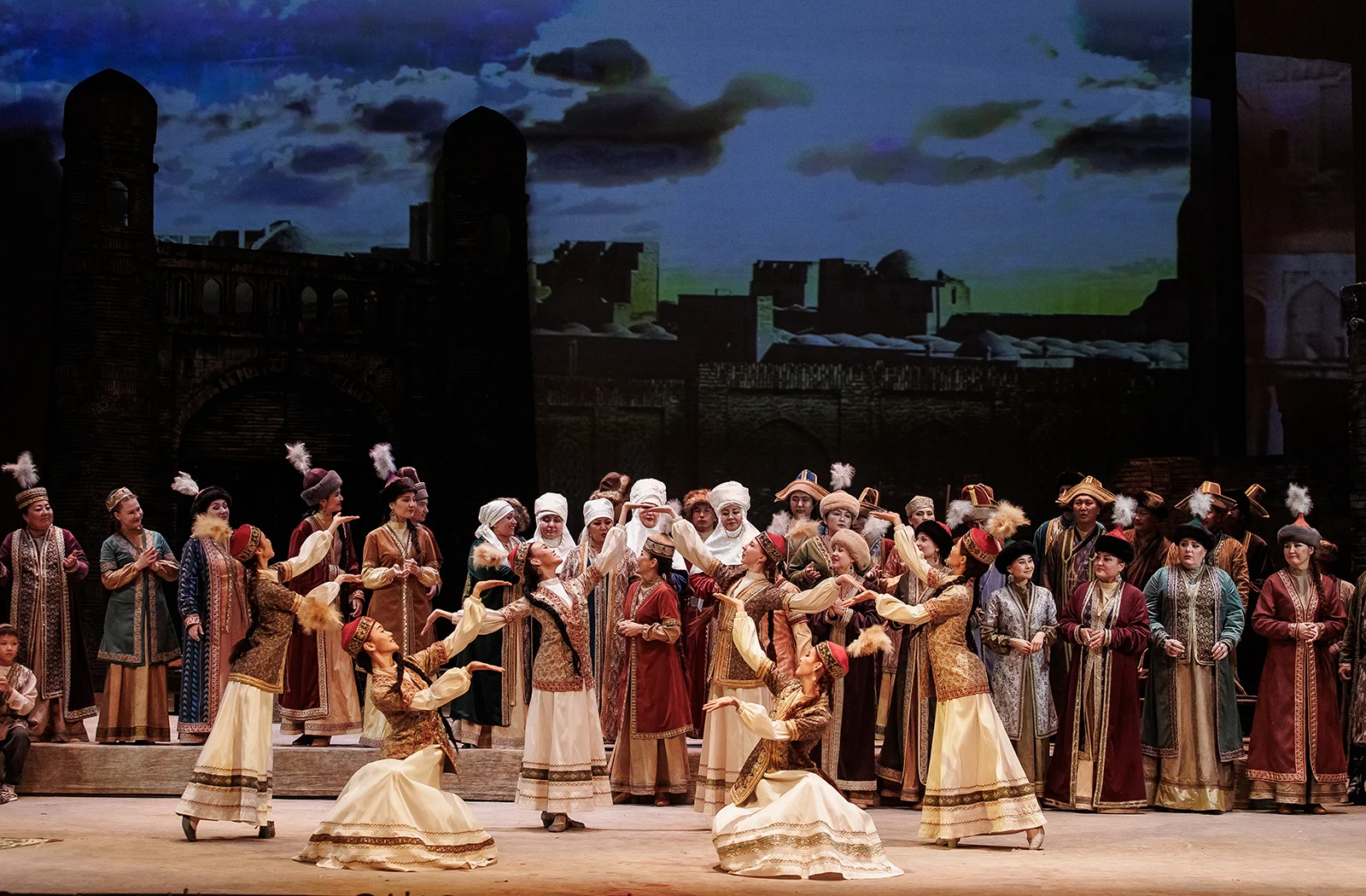
Bekezhan’s leitmotif songs emphasize pride, strength, desperate daring and at the same time his evil intent. These are the songs “Aққum”, “Zhiyrma bes”, “Kokzhendet”, “Madi” and “Sarymoyyn”. Kyuis also constitute an important part of the music of the opera. In “Kyz-Zhibek”, out of twelve kyuis, eight are heard without the participation of soloists or chorus, performed only by the orchestra as accompaniment to dance scenes. For example, the kyui “Ayzhan Kyz” is embodied in the dances of Zhibek’s friends, while the energetic dance of the dzhigits is based on the kyui “Tepen kok”. In the scene of Zhibek’s dream, the kyuis “Shalkyma” and “Bes tore” are heard.
The artistic value and historical significance of Kazakh opera are also defined by its organic connection with national classical literature.
The libretto of the opera “Kyz-Zhibek”, written by Gabit Musrepov, is based on one of the most poetic folk legends about the beautiful Zhibek and the noble Tulegen, whose radiant images are preserved in the people’s memory as symbols of love and fidelity.
The classic of Kazakh literature, Gabit Musrepov, made a significant contribution to all spheres of spiritual culture – drama and musical theatre, as well as cinema. He worked especially fruitfully in the genre of national opera. Perceiving it as one of the highest achievements of human civilization, acutely sensing the specificity of the genre and appreciating its richest expressive resources, Musrepov wrote librettos for Kazakh operas throughout his creative life.
The lyric-epic opera “Kyz-Zhibek” is the first Kazakh opera and forms part of the golden treasury of the nation’s musical art. One may say that it is a work of collective creativity, since the first performers took an active part in its creation, sharing folk musical material with the composer. Its premiere took place on November 7, 1934 in Alma-Ata, and on May 17, 1936, the opera was performed in Moscow on the stage of the Bolshoi Theatre, presenting the young theatre beyond the borders of the republic for the first time. This event was celebrated as a great holiday in the history of Kazakh musical culture. The outstanding performer of the leading role was Kulyash Baiseitova, who received the high title of People’s Artist of the USSR for this part. Thanks to her talent, the lyric-dramatic opera-poem about the tragic fate of the beautiful Zhibek was filled with truthfulness of life and deep inner meaning. “Gakku” remained forever her swan song.
The poem “Kyz-Zhibek” is one of the finest works of the Kazakh epic tradition and is included in the world cultural heritage. This romantic epic, unfolding at the beginning of the 16th century, was recorded in the 19th century and first published in Kazan in 1894 in a version prepared by the Kazakh ethnographer and poet Zhusipbek Shaikhislamuly. In 1988, the poem was translated into Russian by Bakhytzhan Kanapyanov.
The year 2008 was declared by UNESCO as the year of the 500th anniversary of the epic. In 2009, within the framework of the jubilee celebrations, the opera in concert performance was presented in Turkey through TURKSOY in the cities of Istanbul and Mersin. The leading roles were performed by soloists of our theatre.
Y. Brusilovsky
Kyz – Zhibek
opera in 4 acts
libretto by G. Musrepov
Production team:
Conductor – stage director – Kanat Omarov
Stage Director – Mikhail Panjavidze (Russia)
Chief choirmaster – Aliya Temirbekova
Choreographers – directors – Gulzhan Tutkibayeva, People’s Artist of the Republic of Kazakhstan,
Aygul Tati, Honored Figure of the Republic of Kazakhstan
Production designers – Pavel Dragunov, Honored Figure of the Republic of Kazakhstan,
Sofya Tasmagambetova, Honored Figure of the Republic of Kazakhstan
Video Designer – Yerbol Bisenov
Lighting Designer – Sergey Shevchenko (Russia)
Musical director – Bazargali Zhamanbayev, People’s Artist of the Republic of Kazakhstan, Professor
Stage Director’s Assistant – Diana Akimbayeva
Characters
- Zhibek
- Tulegen
- Bekezhan
- Shege
- Bazarbay
- Duriya
- Batsayy
- Karlygash
- Kamka
- Sansyzbay
- Kos-aga
Kyz Zhibek the whole world is by her beauty
Exceeds unearthly –
Is it only Majnun with Layla
They could argue with her…
Smile of morning on the face
In the delicate haze of nacre
In braids – the gold is shining.
First act
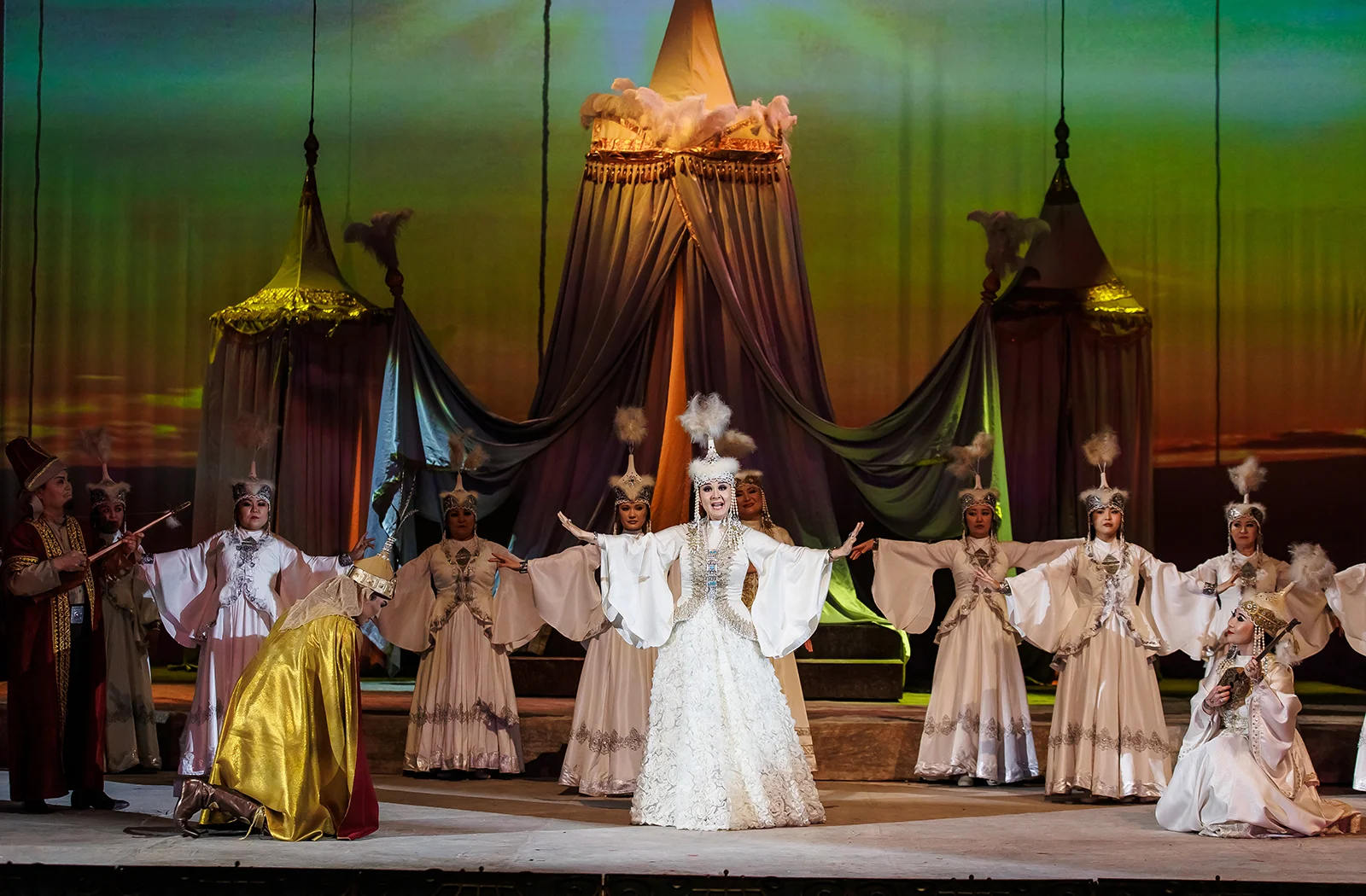
Far, far across the steppe, rumors spread about the unprecedented beauty and unheard-of wisdom of Kyz Zhibek. From the most distant lands, grooms come to woo the beauty, but they return home empty-handed. Zhibek has firmly decided to marry only the man she loves. Until now, no one has won her heart.
Bekezhan has long been in love with Kyz Zhibek. With boasting and unrestrained daring, he vainly tries to win the beauty’s favor.
The young man Tulegen has travelled a long way to see the one whose beauty has become a legend.
The akyn Shege sings of the incomparable достоинства of Kyz Zhibek.
Her meeting with Tulegen kindles in her heart the joyful feeling of first love. Blinded by jealousy, Bekezhan vows cruel revenge upon his rival.
Second act
The rich estate of Bazarbay. Friends are preparing to send Tulegen on his way. Once again, he is setting out on a long journey to his bride. However, the willful and power-hungry Bazarbay does not want even to hear of his marriage. He cares nothing for his son’s feelings. He intends to choose a bride himself.
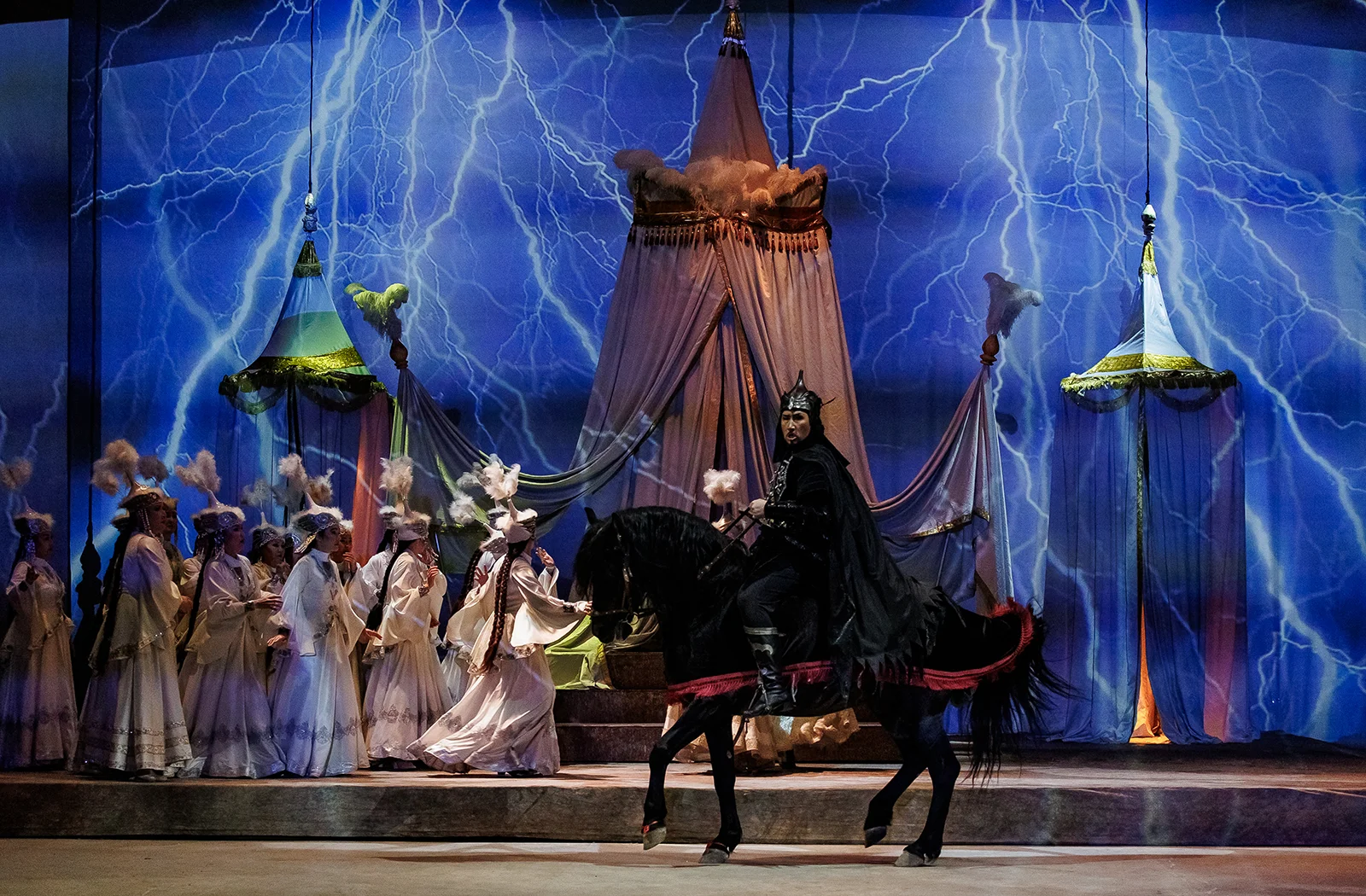
Bekezhan appears with dzhigits. He provokes a quarrel and challenges Tulegen to a duel.
The brave Tulegen is ready to fight Bekezhan in open battle. Inspired by victory, he decides to defy his father’s will and, despite Bazarbay’s prohibition, set out for Kyz Zhibek.
Third act
First picture
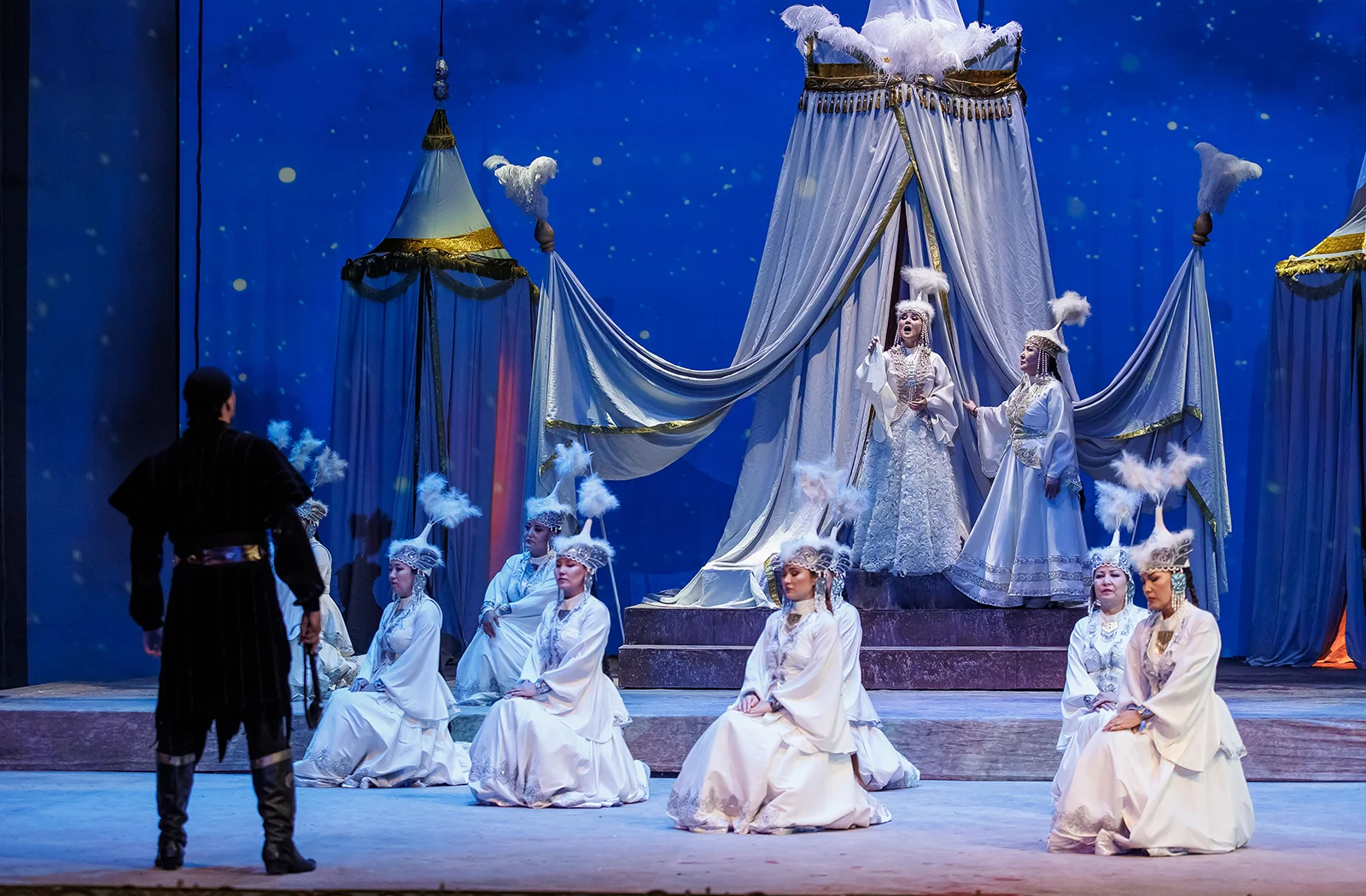
Bekezhan conceives a dark and dishonorable deed. He decides to lie in wait for Tulegen on the road, attack him and treacherously kill him.
Repeating the name of his beloved, Tulegen dies.
Fourth act
First picture
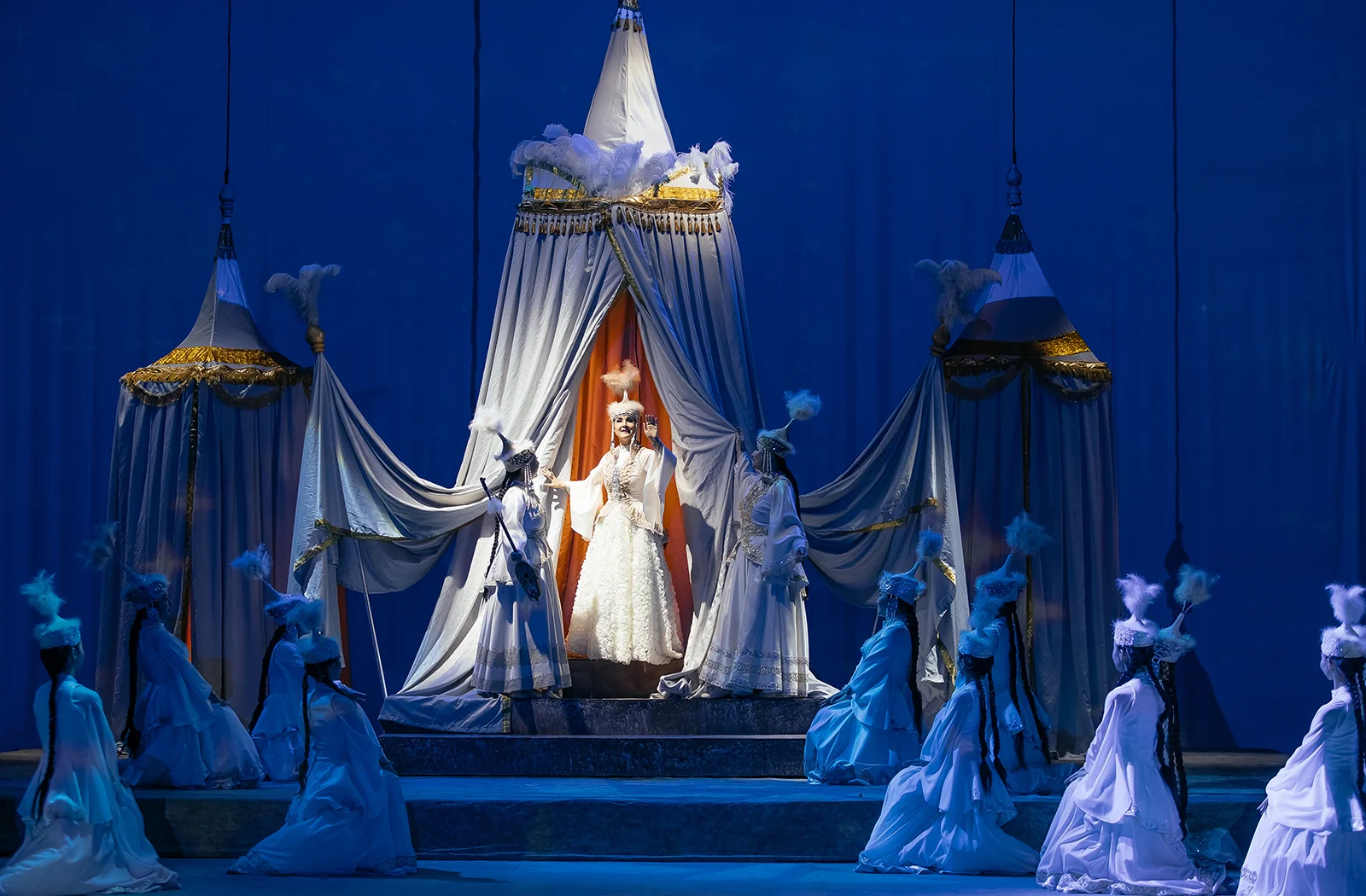
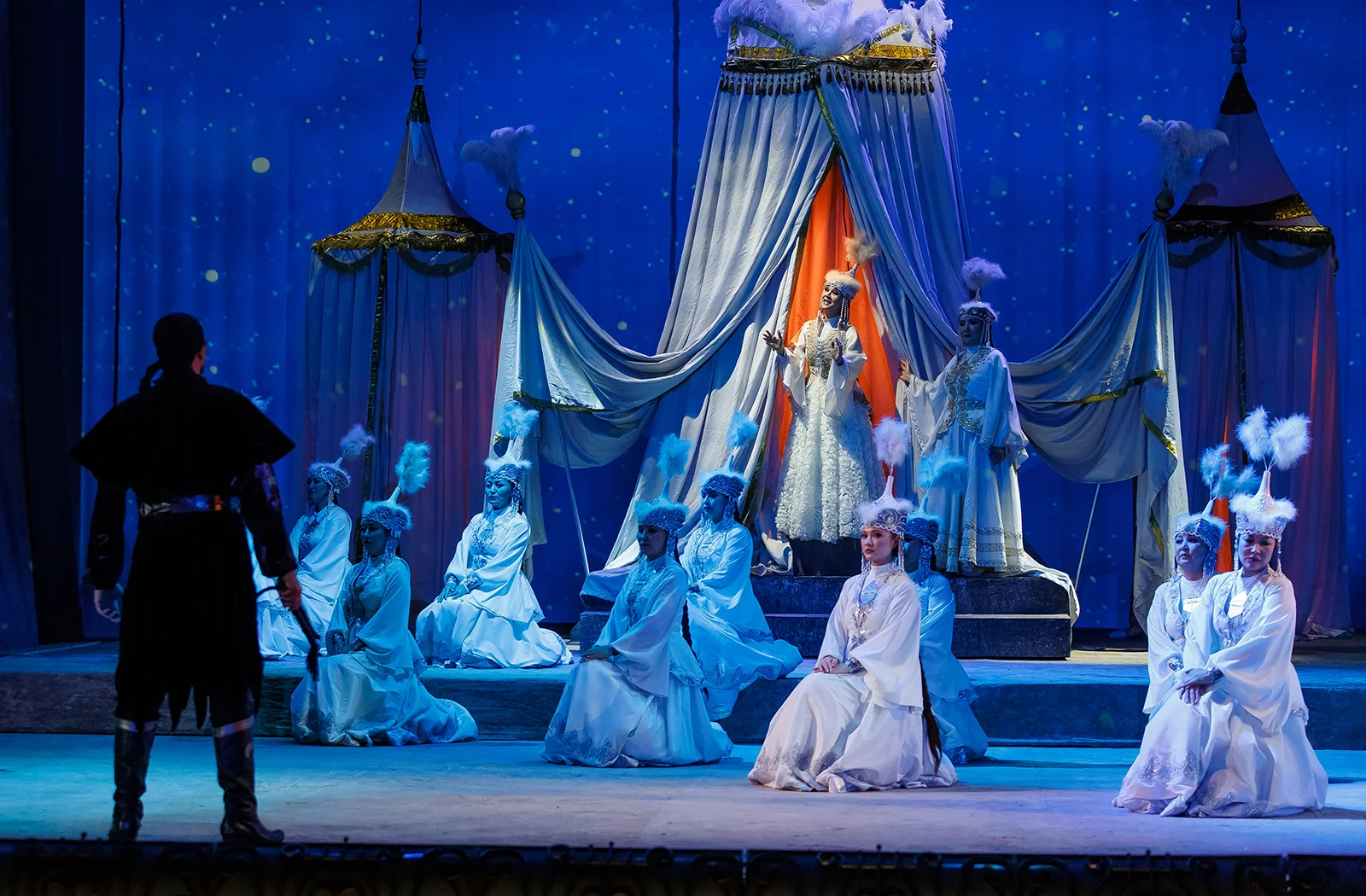
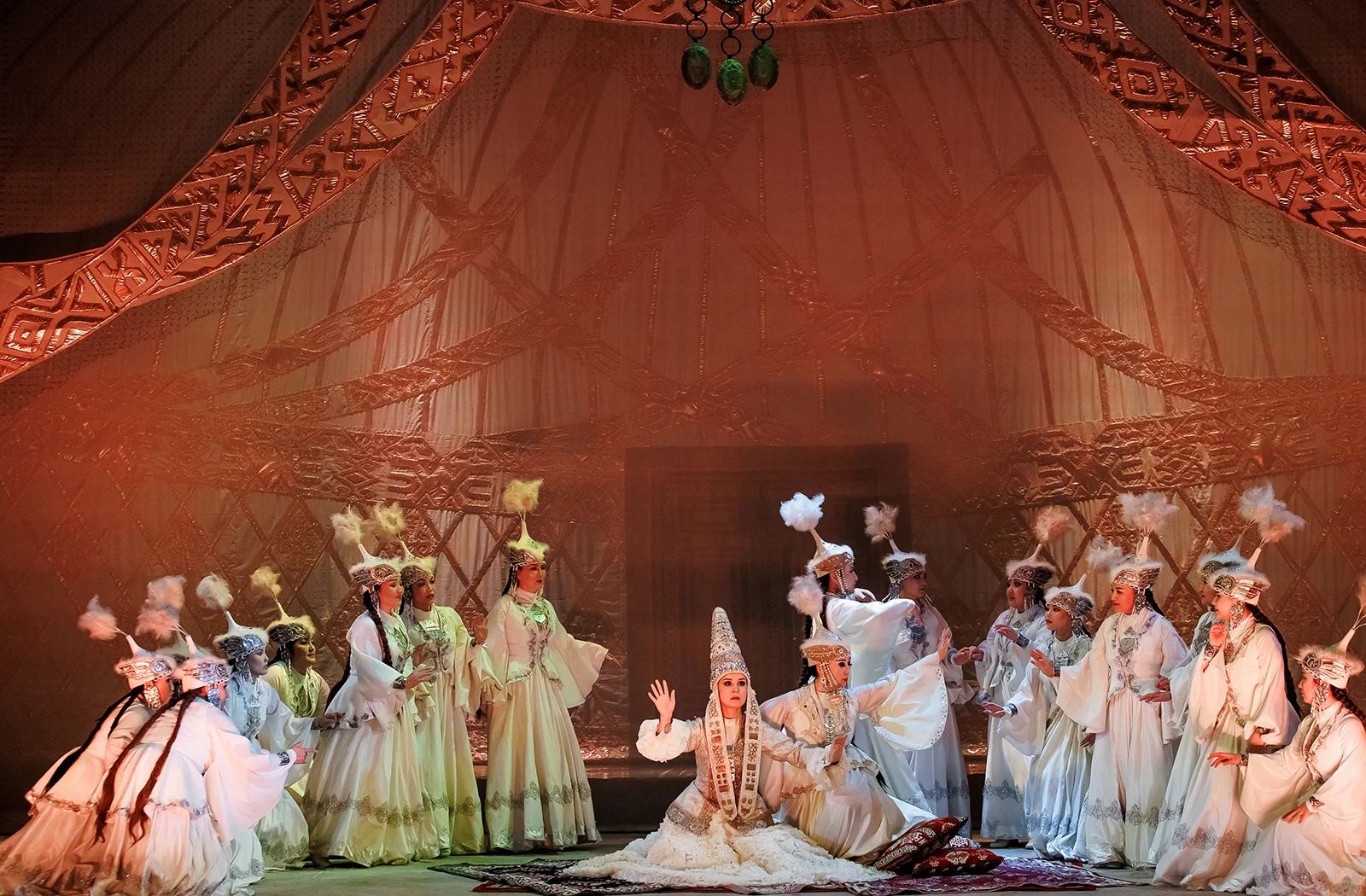
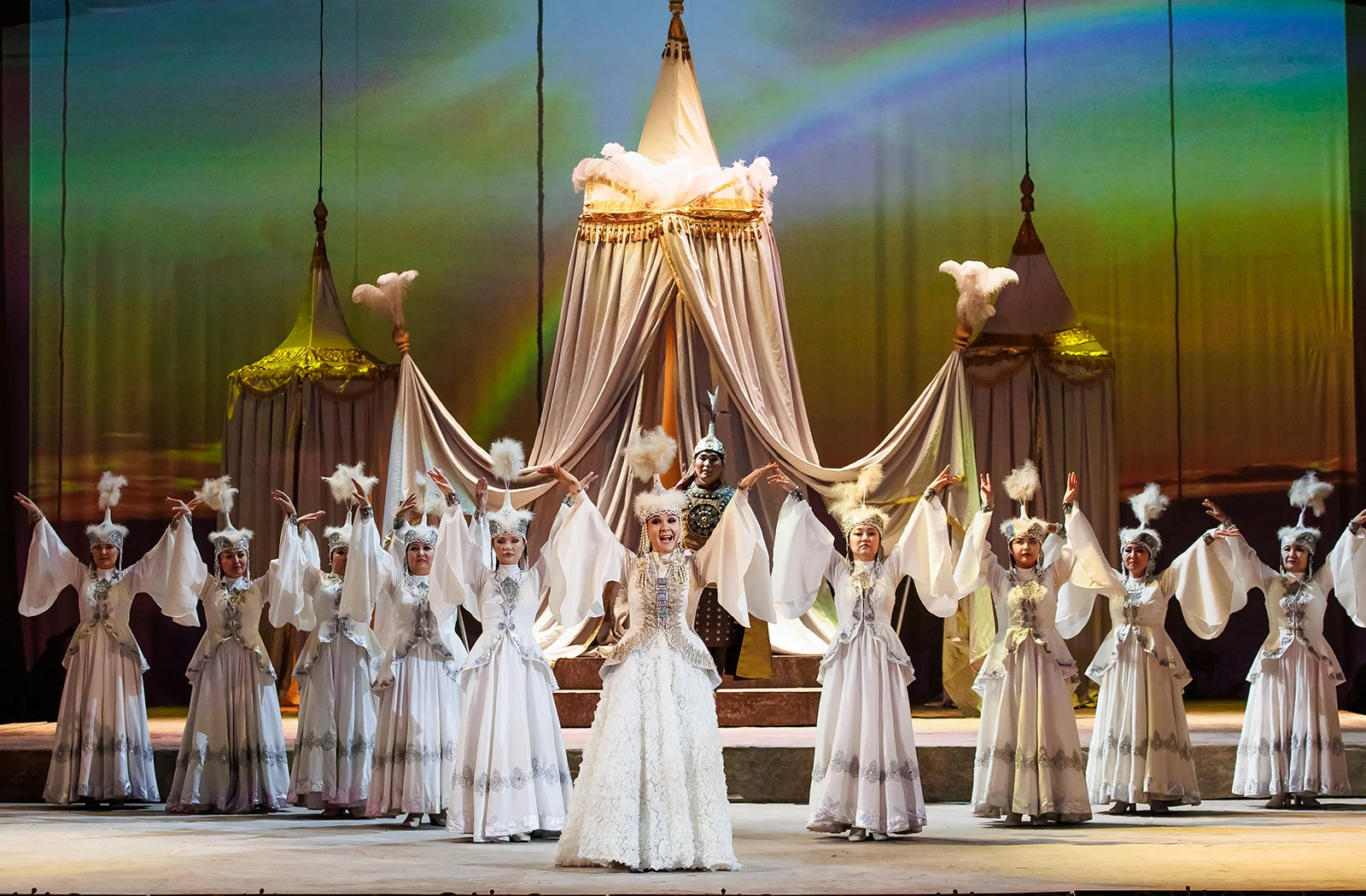
Kyz Zhibek is alone in her yurt. Unnoticed by herself, she falls asleep. The girl dreams that, surrounded by her friends, she is going to meet Tulegen. She rushes toward her bridegroom and suddenly, in horror, sees nothing before her but emptiness. Like one mad, Kyz Zhibek wanders in search of Tulegen… But he is nowhere to be found.
Second picture
Awakening in тревога and agitation, Kyz Zhibek tells her friend Duriya about the dream. Duriya tries to calm the girl, saying that no matter how frightening the dream may be, it foretells good.
Bekezhan bursts in. He brings terrible news: Tulegen has been killed in a duel!
Beside herself with grief, Kyz Zhibek curses the murderer.
Misfortune breaks the girl. Life without her beloved means nothing to her. Zhibek leaves this world out of longing. As a luminous memory of faithful love and of the beautiful Kyz Zhibek, the song “Gakku” is heard.
A lyrical epic opera about love, loyalty, and a tragic fate, where the beauty of Kazakh musical heritage is revealed in heartfelt music and a poetic plot. The story of Kyz Zhibek and Tulegen is imbued with deep emotion, national flavor, and an emotional power that makes this production truly memorable.
“Whatever music I created, it turned back to be Kazakh…”, – this is how the composer Yevgeny Grigorievich Brusilovsky said. His work, inextricably linked with the development of Kazakh national opera art and musical culture, evokes a genuine sense of admiration. The music of the opera “Kyz-Zhibek” is entirely based on folklore material. It includes more than fifty kyuis and songs, which are among the finest examples of folk music and poetry.
To shape the characters, the composer used vocal and instrumental music of different themes, genres and moods, organically reflecting the inner essence of each figure. Thus, the main heroine Zhibek has her own circle of songs that outlines her various psychological states. These are the ecstatic and jubilant “Gakku”, the tender “Tolkyma”, the tragic “Dunie-ai”, and the resolute “Raushan”, written by folk composers Ybyray Sandybaev, Aitbai Gabbasov, Mukhit Meraliev and others. As musical characteristics of Tulegen, the songs “Kos baraban”, “Alkaray kok” and “Karakoz” are used, emphasizing the hero’s nobility, his longing for happiness, and his unwillingness to remain confined within the framework of tradition.
Bekezhan’s leitmotif songs emphasize pride, strength, desperate daring and at the same time his evil intent. These are the songs “Aққum”, “Zhiyrma bes”, “Kokzhendet”, “Madi” and “Sarymoyyn”. Kyuis also constitute an important part of the music of the opera. In “Kyz-Zhibek”, out of twelve kyuis, eight are heard without the participation of soloists or chorus, performed only by the orchestra as accompaniment to dance scenes. For example, the kyui “Ayzhan Kyz” is embodied in the dances of Zhibek’s friends, while the energetic dance of the dzhigits is based on the kyui “Tepen kok”. In the scene of Zhibek’s dream, the kyuis “Shalkyma” and “Bes tore” are heard.
The artistic value and historical significance of Kazakh opera are also defined by its organic connection with national classical literature.
The libretto of the opera “Kyz-Zhibek”, written by Gabit Musrepov, is based on one of the most poetic folk legends about the beautiful Zhibek and the noble Tulegen, whose radiant images are preserved in the people’s memory as symbols of love and fidelity.
The classic of Kazakh literature, Gabit Musrepov, made a significant contribution to all spheres of spiritual culture – drama and musical theatre, as well as cinema. He worked especially fruitfully in the genre of national opera. Perceiving it as one of the highest achievements of human civilization, acutely sensing the specificity of the genre and appreciating its richest expressive resources, Musrepov wrote librettos for Kazakh operas throughout his creative life.
The lyric-epic opera “Kyz-Zhibek” is the first Kazakh opera and forms part of the golden treasury of the nation’s musical art. One may say that it is a work of collective creativity, since the first performers took an active part in its creation, sharing folk musical material with the composer. Its premiere took place on November 7, 1934 in Alma-Ata, and on May 17, 1936, the opera was performed in Moscow on the stage of the Bolshoi Theatre, presenting the young theatre beyond the borders of the republic for the first time. This event was celebrated as a great holiday in the history of Kazakh musical culture. The outstanding performer of the leading role was Kulyash Baiseitova, who received the high title of People’s Artist of the USSR for this part. Thanks to her talent, the lyric-dramatic opera-poem about the tragic fate of the beautiful Zhibek was filled with truthfulness of life and deep inner meaning. “Gakku” remained forever her swan song.
The poem “Kyz-Zhibek” is one of the finest works of the Kazakh epic tradition and is included in the world cultural heritage. This romantic epic, unfolding at the beginning of the 16th century, was recorded in the 19th century and first published in Kazan in 1894 in a version prepared by the Kazakh ethnographer and poet Zhusipbek Shaikhislamuly. In 1988, the poem was translated into Russian by Bakhytzhan Kanapyanov.
The year 2008 was declared by UNESCO as the year of the 500th anniversary of the epic. In 2009, within the framework of the jubilee celebrations, the opera in concert performance was presented in Turkey through TURKSOY in the cities of Istanbul and Mersin. The leading roles were performed by soloists of our theatre.
Y. Brusilovsky
Kyz – Zhibek
opera in 4 acts
libretto by G. Musrepov
Production team:
Conductor – stage director – Kanat Omarov
Stage Director – Mikhail Panjavidze (Russia)
Chief choirmaster – Aliya Temirbekova
Choreographers – directors – Gulzhan Tutkibayeva, People’s Artist of the Republic of Kazakhstan,
Aygul Tati, Honored Figure of the Republic of Kazakhstan
Production designers – Pavel Dragunov, Honored Figure of the Republic of Kazakhstan,
Sofya Tasmagambetova, Honored Figure of the Republic of Kazakhstan
Video Designer – Yerbol Bisenov
Lighting Designer – Sergey Shevchenko (Russia)
Musical director – Bazargali Zhamanbayev, People’s Artist of the Republic of Kazakhstan, Professor
Stage Director’s Assistant – Diana Akimbayeva
Characters
- Zhibek
- Tulegen
- Bekezhan
- Shege
- Bazarbay
- Duriya
- Batsayy
- Karlygash
- Kamka
- Sansyzbay
- Kos-aga
Kyz Zhibek the whole world is by her beauty
Exceeds unearthly –
Is it only Majnun with Layla
They could argue with her…
Smile of morning on the face
In the delicate haze of nacre
In braids – the gold is shining.
First act
Far, far across the steppe, rumors spread about the unprecedented beauty and unheard-of wisdom of Kyz Zhibek. From the most distant lands, grooms come to woo the beauty, but they return home empty-handed. Zhibek has firmly decided to marry only the man she loves. Until now, no one has won her heart.
Bekezhan has long been in love with Kyz Zhibek. With boasting and unrestrained daring, he vainly tries to win the beauty’s favor.
The young man Tulegen has travelled a long way to see the one whose beauty has become a legend.
The akyn Shege sings of the incomparable достоинства of Kyz Zhibek.
Her meeting with Tulegen kindles in her heart the joyful feeling of first love. Blinded by jealousy, Bekezhan vows cruel revenge upon his rival.
Second act
The rich estate of Bazarbay. Friends are preparing to send Tulegen on his way. Once again, he is setting out on a long journey to his bride. However, the willful and power-hungry Bazarbay does not want even to hear of his marriage. He cares nothing for his son’s feelings. He intends to choose a bride himself.
Bekezhan appears with dzhigits. He provokes a quarrel and challenges Tulegen to a duel.
The brave Tulegen is ready to fight Bekezhan in open battle. Inspired by victory, he decides to defy his father’s will and, despite Bazarbay’s prohibition, set out for Kyz Zhibek.
Third act
First picture
Bekezhan conceives a dark and dishonorable deed. He decides to lie in wait for Tulegen on the road, attack him and treacherously kill him.
Repeating the name of his beloved, Tulegen dies.
Fourth act
First picture
Kyz Zhibek is alone in her yurt. Unnoticed by herself, she falls asleep. The girl dreams that, surrounded by her friends, she is going to meet Tulegen. She rushes toward her bridegroom and suddenly, in horror, sees nothing before her but emptiness. Like one mad, Kyz Zhibek wanders in search of Tulegen… But he is nowhere to be found.
Second picture
Awakening in тревога and agitation, Kyz Zhibek tells her friend Duriya about the dream. Duriya tries to calm the girl, saying that no matter how frightening the dream may be, it foretells good.
Bekezhan bursts in. He brings terrible news: Tulegen has been killed in a duel!
Beside herself with grief, Kyz Zhibek curses the murderer.
Misfortune breaks the girl. Life without her beloved means nothing to her. Zhibek leaves this world out of longing. As a luminous memory of faithful love and of the beautiful Kyz Zhibek, the song “Gakku” is heard.
Cast and Performers
(April 25, 2026, 18:00)
- Zhibek Venera Alpysbayeva
- Tolegen Nurzhan Bazhekenov, Honored Worker of the Republic of Kazakhstan
- Bekezhan Dulat Tokanov
- Karlygash Ayazhan Kuanshaliyeva
- Kamka Dina Khamzina, Honored Worker of the Republic of Kazakhstan
- Duriya Nadiya Nadenova
- Bazarbay Kairat Omirbekov
- Shege Darkhan Zholdybayev
- Batsay Zhadra Amanova
- Altybas Askar Rysbek
- Sansyzbay Nurgalym Amanbay
-
Symphony Orchestra, chorus and ballet of the Kazakh National Opera and Ballet Theatre named after Abay
- Conductor – Kuanysh Ismailov
Gallery
Gallery