Opera
Tosca October 31, 2026, 19:00
Description
October 30 and 31 — a GRAND PREMIERE at the Abai Kazakh National Opera and Ballet Theatre!
Passion, jealousy, betrayal, and a love worth sacrificing one’s life for…
One of Giacomo Puccini’s most dramatic and emotionally powerful operas, Tosca, will be presented to Almaty audiences in a production by world-renowned Italian director Stefano Poda!
His name is synonymous with bold artistic vision, breathtaking stage design, and captivating theatrical aesthetics. In Stefano Poda’s productions, music, light, space, and movement merge into a unified work of art.
Having captivated audiences at the Royal Theatre of Turin and the Bolshoi Theatre of Russia, this production will now come to life on the stage of the Abai Theatre!
Tosca is more than an opera. It is a story of all-consuming love, desperate choices, and tragic fate, told through the language of magnificent music and striking stage imagery.
Two evenings that promise to become one of the most remarkable theatrical events of the autumn!
October 30 & 31 | Abai Theatre
Don’t miss the premiere!
Production sponsors:
Freedom Shapagat Corporate Foundation;
Italian Cultural Institute in Almaty;
Embassy of Italy in the Republic of Kazakhstan.
This Tosca is part of my artistic journey in search of a new language for opera. I believe that today the greatest risk is to reduce opera to a psychological illustration or a cinematic narrative, forgetting that music is of a different nature: music does not describe, explain or argue; it evokes. It is spirit, memory and mystery, not mere storytelling.
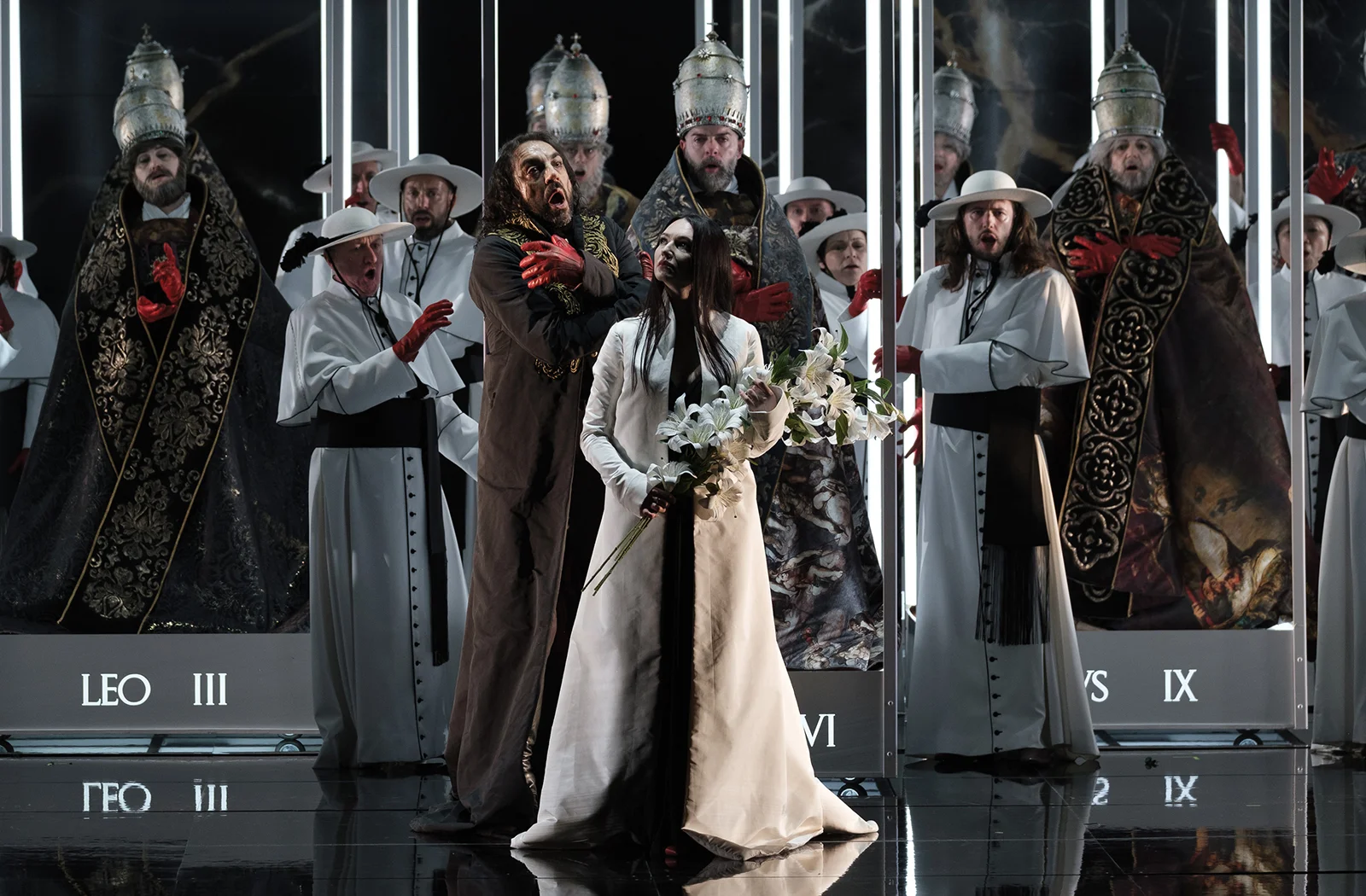
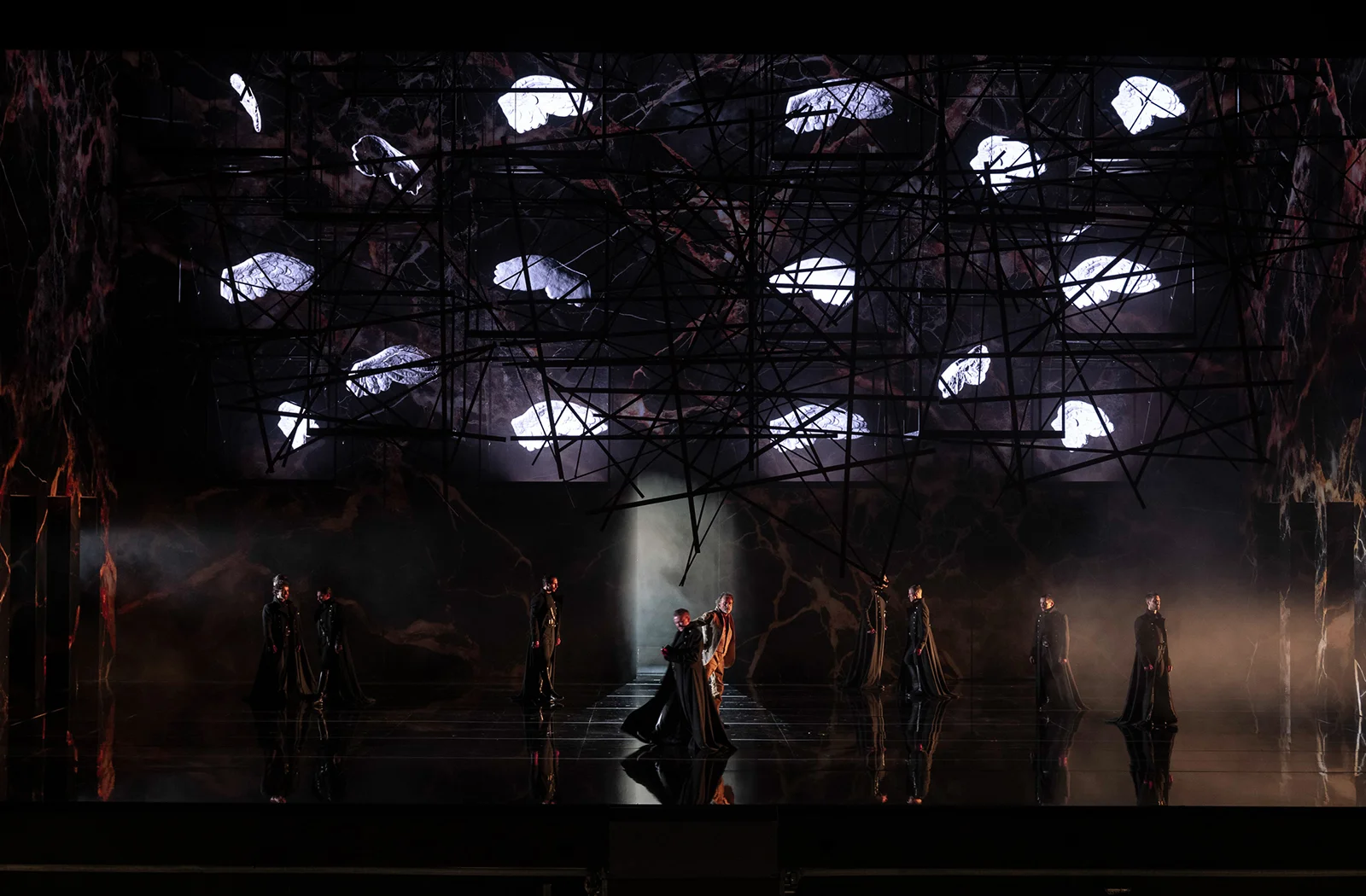
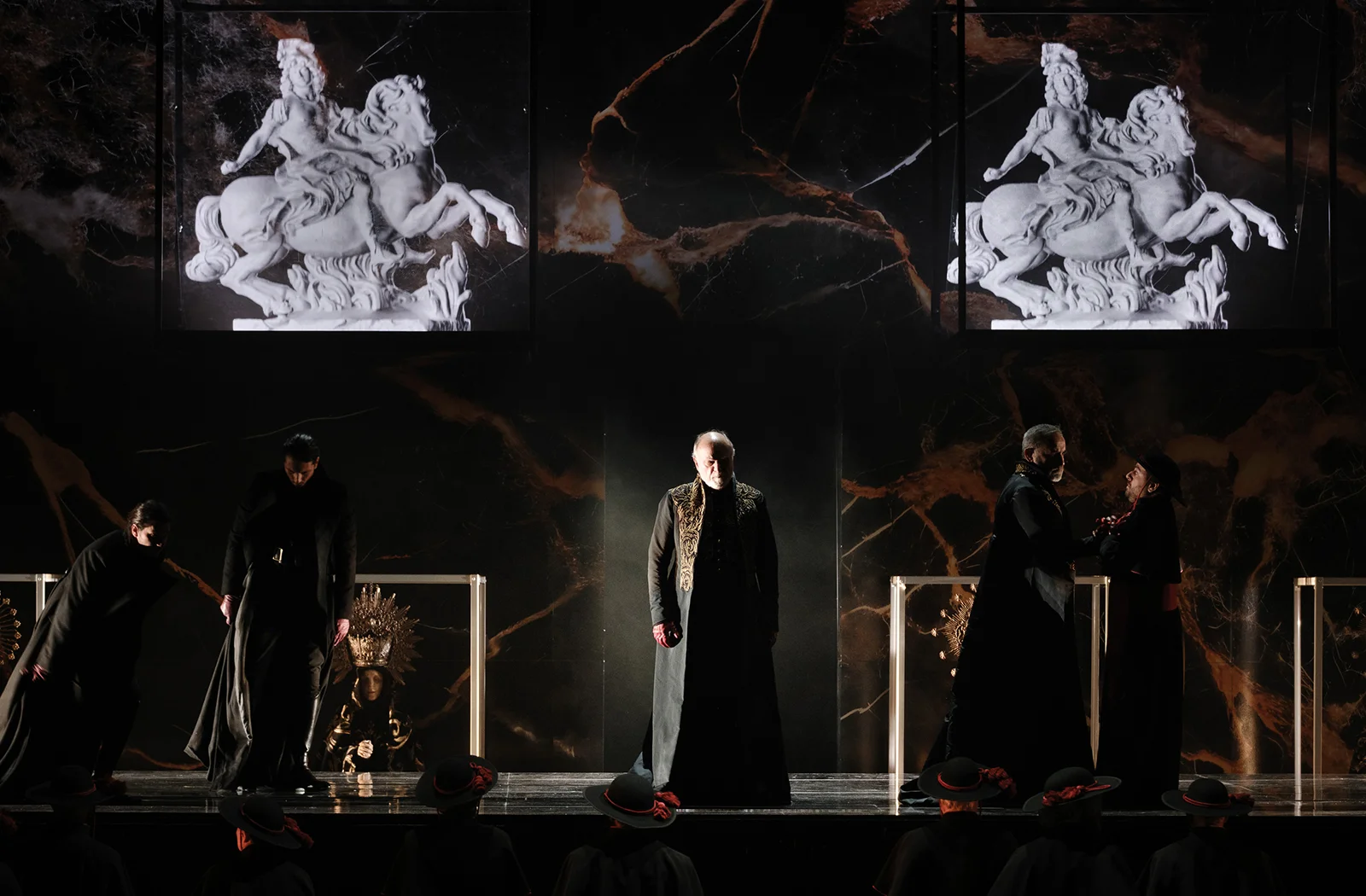
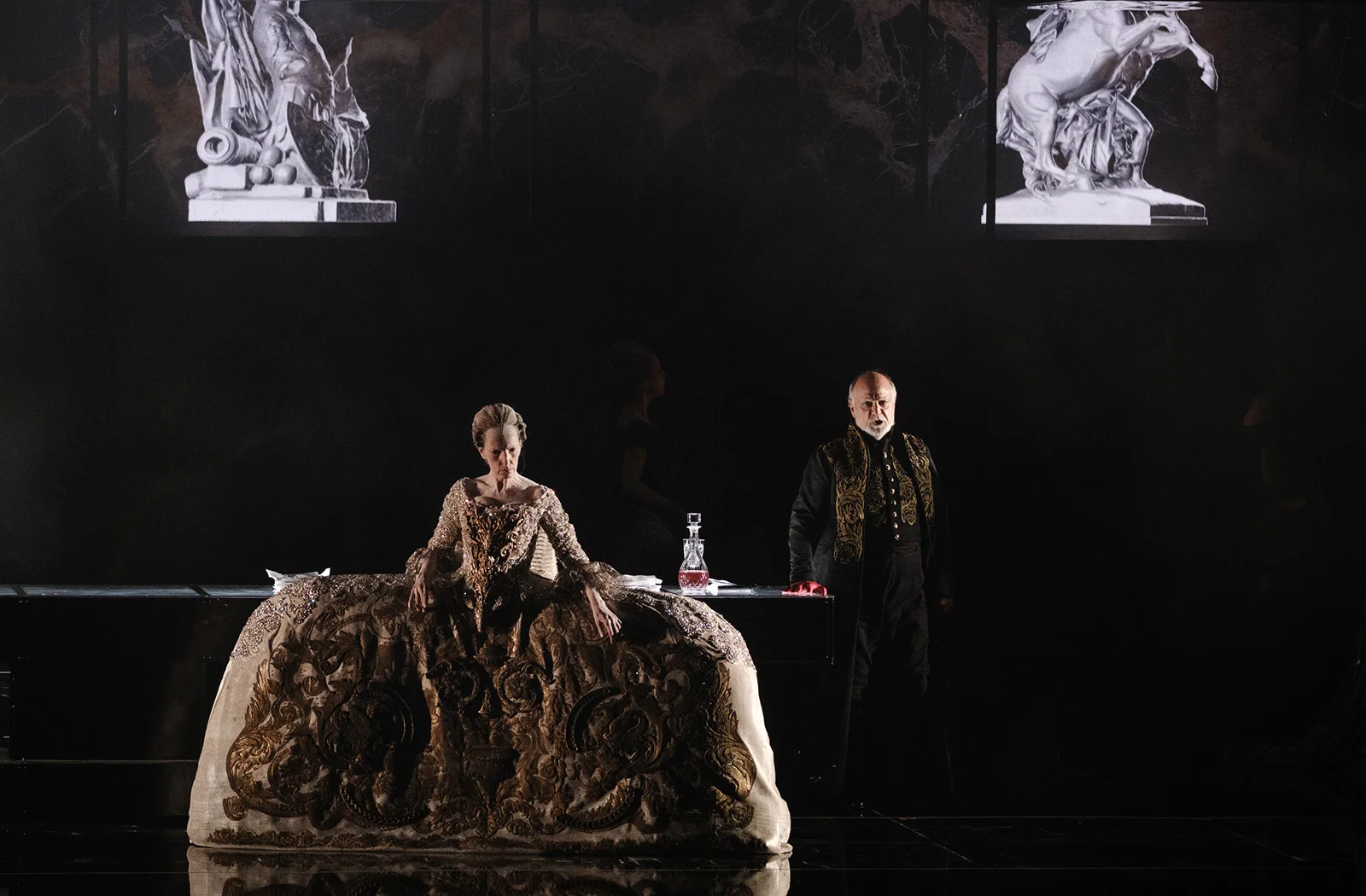
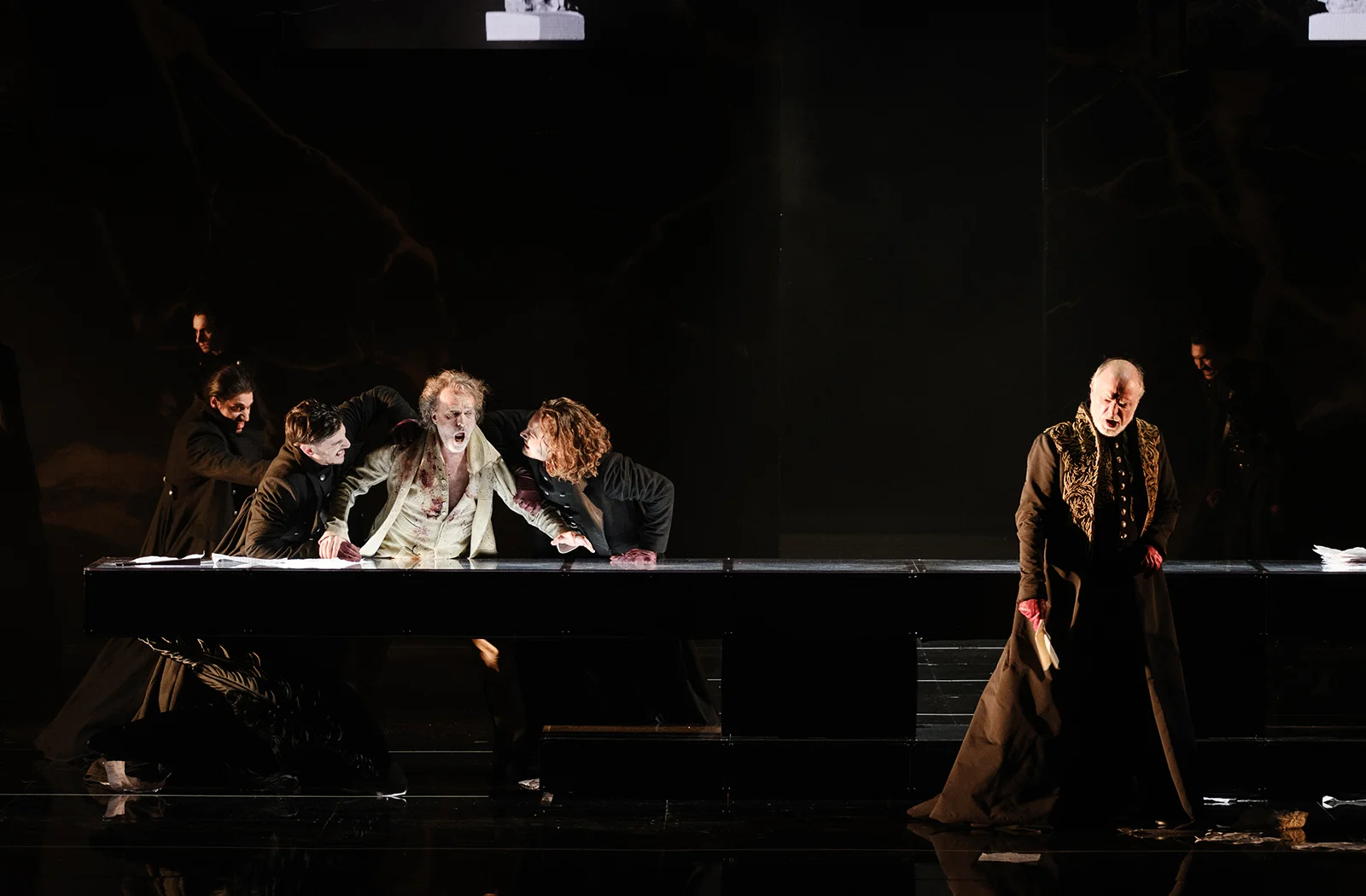
The action unfolds in a monumental space of marble, light and architecture, in which the ancient matter of Roman history is mediated by new technologies such as holograms, whose possibilities I have chosen to explore here in an innovative way. The means of cinema do not work in the theatre; what the theatre needs is the illusion of materiality, and projections and video mapping have already revealed all their limitations. Instead, in the enormous display cases at the back of the stage, we find statues, archaeological artefacts and symbols of Eternal Rome as real holographic presences, suspended between ruin and future.
Within this spatial setting, Tosca becomes the story of a historical passage of extreme violence: the twilight of one world and the emergence of another. On one side stands the dying eighteenth century, the Ancien Régime, with religious and monarchical powers desperately struggling to survive; on the other, the new century advances, bringing revolution, modernity, and political and spiritual transformation. This conflict is not presented didactically; it remains a background noise accompanying deeply personal events.
Around Scarpia revolves a decadent court, marked by the presence of Queen Maria Carolina of Naples, sister of Marie Antoinette of France. She is a symbolic figure of a European elite traumatised by the French Revolution and unable to grasp that history has already entered an irreversible phase of change. Cavaradossi, by contrast, already belongs to a new age: not only because of his political ideas, but because of his very striving towards the future, towards a freedom still undefined yet inevitable.
Tosca stands in the midst of these gigantic forces. And this is perhaps precisely what makes her so modern: her private tragedy coincides, unwittingly, with the tragedy of history. She is not merely a woman swept up in the violence of power, but a human being plunging into the collapse of an entire moral, political and spiritual universe.
For this reason, the stage will never be static. It will be traversed by continuous movement, far beyond cinematic dynamics, in which the chorus, crowds, singers, actors, light and architecture become parts of a single living organism. Musical theatre possesses a power that cinema can never have: the real presence of body and sound in the same instant. It is precisely this physical and ritual energy that, as I see it, we must seek to bring back to the centre of the theatrical experience.
The Te Deum in the first act becomes the culminating point of this dynamic and ritual dimension. A procession of all the popes of Rome crosses the stage like a timeless vision, as part of a ritual that seems to have continued for centuries. This is not merely a picturesque ecclesiastical ceremony, but a gigantic hallucination of power, in which the popes conjured up by Scarpia will be clearly recognisable.
Contemporary theatre perhaps too often loses its deep relationship with mystery. Modern rationality, naturalism and the constant need to explain everything have progressively impoverished the symbolic and irrational dimension that once belonged naturally to ancient art. And yet opera thrives on precisely this paradox: on the one hand, it presents concrete circumstances and historically recognisable settings; on the other, it constantly transcends reality through music. Tosca is an utterly precise story and, at the same time, a dream, or rather a nightmare.
In the finale, when Tosca plunges into the void, space plunges with her. The dark, oppressive universe that has dominated the opera suddenly dissolves into an absolute, almost metaphysical light. Space opens into a liberating flight. There is no longer the weight of matter, no more architecture; only whiteness remains: the very perspective of the fall itself.
To approach Tosca is to confront collective images deeply engraved in the spectator’s memory. There are works that have long since become myths. Tosca, Scarpia and Cavaradossi are not merely characters: they are archetypes. And it is precisely in the face of myth that theatre must find the courage to synthesise memory and transformation, as has happened in every age of genuine artistic creation. The ancient Greeks continually reinvented their myths, of which contradictory versions have survived precisely because every poet could, and indeed had to, change them. Renaissance painters dressed the figures of the Gospel in the clothes of their own time. Theatre, by its very nature, is not the static preservation of the past but a continual regeneration of the imagination. Every age must be able to recognise itself in the great archetypes of the past.
Because, in the end, Tosca is not only about politics, religion or love. It speaks of the terrible and sublime moment when one world ends and another begins. And theatre, as ever, exists precisely for this: to make the invisible visible, to transform history into a living experience, and to allow the spectator not only to watch an opera, but also to look into the depths of their own being.
Stefano Poda
Giacomo Puccini
Tosca
Opera in 3 acts, 8 scenes
Characters:
- Floria Tosca, a celebrated singer – soprano
- Mario Cavaradossi, a painter – tenor
- Baron Scarpia, chief of police – baritone
- Cesare Angelotti, former Consul of the Roman Republic – bass
- A Sacristan – baritone
- Spoletta, a police agent – tenor
- Sciarrone, a gendarme – bass
- A Jailer – bass
- A Shepherd boy – alto
- Soldiers, police agents, altar boys, noblemen and women, townsfolk, artisans
Rome, June 1800.
Act I
Rome, June 1800. Cesare Angelotti, an escaped political prisoner, rushes into the church of Sant’Andrea della Valle. He hides in one of the chapels just before the painter Mario Cavaradossi arrives to work on his portrait of Mary Magdalene. The painting has been inspired by the Marchesa Attavanti, whom Cavaradossi has seen in the church but does not know. He is struck by the resemblance of the dark-haired beauty of his lover, the singer Floria Tosca, and that of the blonde Marchesa Attavanti.
Angelotti, who was a member of the former Bonapartist government, emerges from his hiding place. Cavaradossi recognizes him and promises help, then hurries him back into the chapel as Tosca is heard calling from outside. She jealously asks Cavaradossi whom he has been talking to and reminds him of their rendezvous that evening. Suddenly recognizing the Marchesa Attavanti in the painting, she accuses him of being unfaithful, but he assures her of his love.
When Tosca has left, Angelotti again comes out of hiding. A cannon signals that the police have discovered the escape, and he and Cavaradossi flee to the painter’s house. The sacristan enters with choirboys who are preparing to sing in a Te Deum celebrating the recent victory against Napoleon at the Battle of Marengo. Their excitement is silenced by the arrival of Baron Scarpia, chief of the secret police, who is searching for Angelotti.
When Tosca comes back looking for Cavaradossi, Scarpia shows her a fan with the Attavanti crest that he has just found. Seemingly finding her suspicions about her lover’s infidelity confirmed, Tosca bursts into tears. She vows vengeance and leaves as the church fills with worshippers. Scarpia sends his men to follow her to Cavaradossi, with whom he thinks Angelotti is hiding. While the congregation sings the Te Deum, Scarpia declares that he will bend Tosca to his will.
Act II
In his study at the Palazzo Farnese, Scarpia anticipates the pleasure of having Tosca in his power. The spy Spoletta arrives with news that he was unable to find Angelotti. Instead he brings in Cavaradossi.
While Scarpia interrogates the defiant painter, Tosca is heard singing at a royal gala in the same building. Scarpia sends for her and she appears just as Cavaradossi is being taken away to be tortured. Frightened by Scarpia’s questions and Cavaradossi’s screams, Tosca reveals Angelotti’s hiding place.
Cavaradossi is brought in, badly hurt and hardly conscious. When he realizes what has happened, he angrily confronts Tosca, just as the officer Sciarrone rushes in to announce that Napoleon in fact has won the battle, a defeat for Scarpia’s side. Cavaradossi shouts out his defiance of tyranny and is dragged off to be executed.
Scarpia calmly suggests to Tosca that he would let Cavaradossi go free if she would give herself to him. Fighting off his advances, she declares she has dedicated her life to art and love and calls on God for help. Scarpia insists, when Spoletta interrupts: faced with capture, Angelotti has killed himself.
Tosca, now forced to give in or lose her lover, agrees to Scarpia’s proposition. Scarpia orders Spoletta to prepare for a mock execution of Cavaradossi, after which he is to be freed. Tosca demands that Scarpia write her a safe-conduct. When he has done so, she grabs a knife from a table and stabs him.
Act III
At dawn the next morning, Cavaradossi awaits execution at the Castel Sant’Angelo. He bribes the jailer to deliver a farewell letter to Tosca, then, overcome with emotion, gives in to his despair.
Tosca appears and explains what has happened. The two imagine their future in freedom. As the execution squad arrives, Tosca implores Cavaradossi to fake his death convincingly, then hides.
The soldiers fire and depart. Cavaradossi does not move and Tosca realizes that Scarpia has betrayed her. Just as Spoletta rushes in to arrest her, she leaps from the battlement.
October 30 and 31 — a GRAND PREMIERE at the Abai Kazakh National Opera and Ballet Theatre!
Passion, jealousy, betrayal, and a love worth sacrificing one’s life for…
One of Giacomo Puccini’s most dramatic and emotionally powerful operas, Tosca, will be presented to Almaty audiences in a production by world-renowned Italian director Stefano Poda!
His name is synonymous with bold artistic vision, breathtaking stage design, and captivating theatrical aesthetics. In Stefano Poda’s productions, music, light, space, and movement merge into a unified work of art.
Having captivated audiences at the Royal Theatre of Turin and the Bolshoi Theatre of Russia, this production will now come to life on the stage of the Abai Theatre!
Tosca is more than an opera. It is a story of all-consuming love, desperate choices, and tragic fate, told through the language of magnificent music and striking stage imagery.
Two evenings that promise to become one of the most remarkable theatrical events of the autumn!
October 30 & 31 | Abai Theatre
Don’t miss the premiere!
Production sponsors:
Freedom Shapagat Corporate Foundation;
Italian Cultural Institute in Almaty;
Embassy of Italy in the Republic of Kazakhstan.
This Tosca is part of my artistic journey in search of a new language for opera. I believe that today the greatest risk is to reduce opera to a psychological illustration or a cinematic narrative, forgetting that music is of a different nature: music does not describe, explain or argue; it evokes. It is spirit, memory and mystery, not mere storytelling.
The action unfolds in a monumental space of marble, light and architecture, in which the ancient matter of Roman history is mediated by new technologies such as holograms, whose possibilities I have chosen to explore here in an innovative way. The means of cinema do not work in the theatre; what the theatre needs is the illusion of materiality, and projections and video mapping have already revealed all their limitations. Instead, in the enormous display cases at the back of the stage, we find statues, archaeological artefacts and symbols of Eternal Rome as real holographic presences, suspended between ruin and future.
Within this spatial setting, Tosca becomes the story of a historical passage of extreme violence: the twilight of one world and the emergence of another. On one side stands the dying eighteenth century, the Ancien Régime, with religious and monarchical powers desperately struggling to survive; on the other, the new century advances, bringing revolution, modernity, and political and spiritual transformation. This conflict is not presented didactically; it remains a background noise accompanying deeply personal events.
Around Scarpia revolves a decadent court, marked by the presence of Queen Maria Carolina of Naples, sister of Marie Antoinette of France. She is a symbolic figure of a European elite traumatised by the French Revolution and unable to grasp that history has already entered an irreversible phase of change. Cavaradossi, by contrast, already belongs to a new age: not only because of his political ideas, but because of his very striving towards the future, towards a freedom still undefined yet inevitable.
Tosca stands in the midst of these gigantic forces. And this is perhaps precisely what makes her so modern: her private tragedy coincides, unwittingly, with the tragedy of history. She is not merely a woman swept up in the violence of power, but a human being plunging into the collapse of an entire moral, political and spiritual universe.
For this reason, the stage will never be static. It will be traversed by continuous movement, far beyond cinematic dynamics, in which the chorus, crowds, singers, actors, light and architecture become parts of a single living organism. Musical theatre possesses a power that cinema can never have: the real presence of body and sound in the same instant. It is precisely this physical and ritual energy that, as I see it, we must seek to bring back to the centre of the theatrical experience.
The Te Deum in the first act becomes the culminating point of this dynamic and ritual dimension. A procession of all the popes of Rome crosses the stage like a timeless vision, as part of a ritual that seems to have continued for centuries. This is not merely a picturesque ecclesiastical ceremony, but a gigantic hallucination of power, in which the popes conjured up by Scarpia will be clearly recognisable.
Contemporary theatre perhaps too often loses its deep relationship with mystery. Modern rationality, naturalism and the constant need to explain everything have progressively impoverished the symbolic and irrational dimension that once belonged naturally to ancient art. And yet opera thrives on precisely this paradox: on the one hand, it presents concrete circumstances and historically recognisable settings; on the other, it constantly transcends reality through music. Tosca is an utterly precise story and, at the same time, a dream, or rather a nightmare.
In the finale, when Tosca plunges into the void, space plunges with her. The dark, oppressive universe that has dominated the opera suddenly dissolves into an absolute, almost metaphysical light. Space opens into a liberating flight. There is no longer the weight of matter, no more architecture; only whiteness remains: the very perspective of the fall itself.
To approach Tosca is to confront collective images deeply engraved in the spectator’s memory. There are works that have long since become myths. Tosca, Scarpia and Cavaradossi are not merely characters: they are archetypes. And it is precisely in the face of myth that theatre must find the courage to synthesise memory and transformation, as has happened in every age of genuine artistic creation. The ancient Greeks continually reinvented their myths, of which contradictory versions have survived precisely because every poet could, and indeed had to, change them. Renaissance painters dressed the figures of the Gospel in the clothes of their own time. Theatre, by its very nature, is not the static preservation of the past but a continual regeneration of the imagination. Every age must be able to recognise itself in the great archetypes of the past.
Because, in the end, Tosca is not only about politics, religion or love. It speaks of the terrible and sublime moment when one world ends and another begins. And theatre, as ever, exists precisely for this: to make the invisible visible, to transform history into a living experience, and to allow the spectator not only to watch an opera, but also to look into the depths of their own being.
Stefano Poda
Giacomo Puccini
Tosca
Opera in 3 acts, 8 scenes
Characters:
- Floria Tosca, a celebrated singer – soprano
- Mario Cavaradossi, a painter – tenor
- Baron Scarpia, chief of police – baritone
- Cesare Angelotti, former Consul of the Roman Republic – bass
- A Sacristan – baritone
- Spoletta, a police agent – tenor
- Sciarrone, a gendarme – bass
- A Jailer – bass
- A Shepherd boy – alto
- Soldiers, police agents, altar boys, noblemen and women, townsfolk, artisans
Rome, June 1800.
Act I
Rome, June 1800. Cesare Angelotti, an escaped political prisoner, rushes into the church of Sant’Andrea della Valle. He hides in one of the chapels just before the painter Mario Cavaradossi arrives to work on his portrait of Mary Magdalene. The painting has been inspired by the Marchesa Attavanti, whom Cavaradossi has seen in the church but does not know. He is struck by the resemblance of the dark-haired beauty of his lover, the singer Floria Tosca, and that of the blonde Marchesa Attavanti.
Angelotti, who was a member of the former Bonapartist government, emerges from his hiding place. Cavaradossi recognizes him and promises help, then hurries him back into the chapel as Tosca is heard calling from outside. She jealously asks Cavaradossi whom he has been talking to and reminds him of their rendezvous that evening. Suddenly recognizing the Marchesa Attavanti in the painting, she accuses him of being unfaithful, but he assures her of his love.
When Tosca has left, Angelotti again comes out of hiding. A cannon signals that the police have discovered the escape, and he and Cavaradossi flee to the painter’s house. The sacristan enters with choirboys who are preparing to sing in a Te Deum celebrating the recent victory against Napoleon at the Battle of Marengo. Their excitement is silenced by the arrival of Baron Scarpia, chief of the secret police, who is searching for Angelotti.
When Tosca comes back looking for Cavaradossi, Scarpia shows her a fan with the Attavanti crest that he has just found. Seemingly finding her suspicions about her lover’s infidelity confirmed, Tosca bursts into tears. She vows vengeance and leaves as the church fills with worshippers. Scarpia sends his men to follow her to Cavaradossi, with whom he thinks Angelotti is hiding. While the congregation sings the Te Deum, Scarpia declares that he will bend Tosca to his will.
Act II
In his study at the Palazzo Farnese, Scarpia anticipates the pleasure of having Tosca in his power. The spy Spoletta arrives with news that he was unable to find Angelotti. Instead he brings in Cavaradossi.
While Scarpia interrogates the defiant painter, Tosca is heard singing at a royal gala in the same building. Scarpia sends for her and she appears just as Cavaradossi is being taken away to be tortured. Frightened by Scarpia’s questions and Cavaradossi’s screams, Tosca reveals Angelotti’s hiding place.
Cavaradossi is brought in, badly hurt and hardly conscious. When he realizes what has happened, he angrily confronts Tosca, just as the officer Sciarrone rushes in to announce that Napoleon in fact has won the battle, a defeat for Scarpia’s side. Cavaradossi shouts out his defiance of tyranny and is dragged off to be executed.
Scarpia calmly suggests to Tosca that he would let Cavaradossi go free if she would give herself to him. Fighting off his advances, she declares she has dedicated her life to art and love and calls on God for help. Scarpia insists, when Spoletta interrupts: faced with capture, Angelotti has killed himself.
Tosca, now forced to give in or lose her lover, agrees to Scarpia’s proposition. Scarpia orders Spoletta to prepare for a mock execution of Cavaradossi, after which he is to be freed. Tosca demands that Scarpia write her a safe-conduct. When he has done so, she grabs a knife from a table and stabs him.
Act III
At dawn the next morning, Cavaradossi awaits execution at the Castel Sant’Angelo. He bribes the jailer to deliver a farewell letter to Tosca, then, overcome with emotion, gives in to his despair.
Tosca appears and explains what has happened. The two imagine their future in freedom. As the execution squad arrives, Tosca implores Cavaradossi to fake his death convincingly, then hides.
The soldiers fire and depart. Cavaradossi does not move and Tosca realizes that Scarpia has betrayed her. Just as Spoletta rushes in to arrest her, she leaps from the battlement.
Cast and Performers
(October 31, 2026, 19:00)
- Director, Choreographer, Costume and Lighting Designer Стефано Пода
- Assistant Director, Chief Assistant Паоло Джани Чей
Gallery
Gallery