
No Wigs Were Thrown
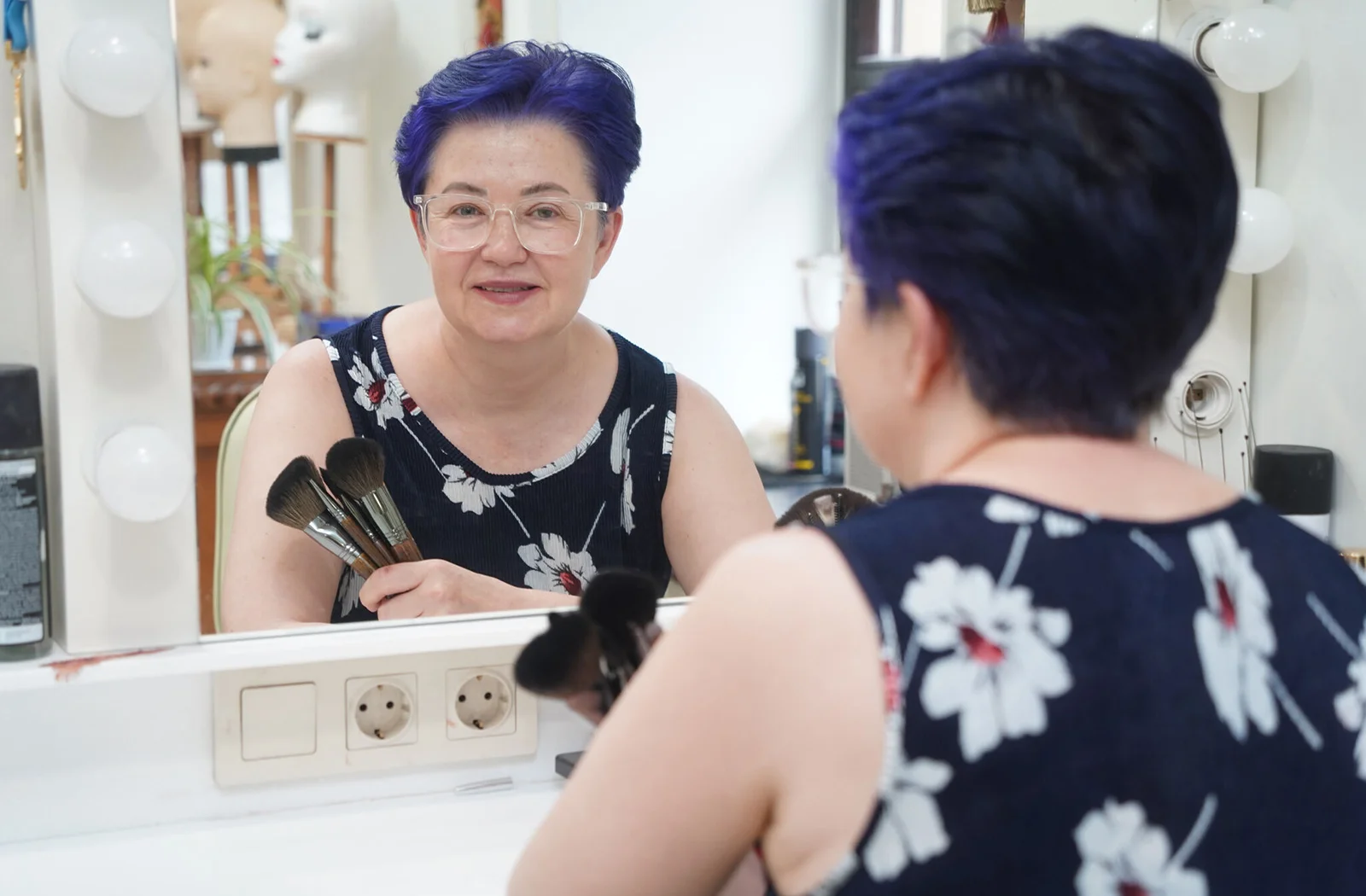
Renowned make-up artist Elena Konovalova is firmly against revealing backstage secrets, yet she still shared with us how she managed to work at the Kazakh National Opera and Ballet Theatre for no less than 39 years.
– I came here when I was still a girl, I was only 22. And I did my very first make-up when I was five. The man I am painting here is my father, — Elena Nikolaevna smiles and shows an old black-and-white photograph. — He was a performer of the original genre, an illusionist — or, simply put, a magician — at Kazakhconcert. I loved it when, instead of going to kindergarten, I could spend time at my father’s workplace. Back then, Kazakhconcert was located in what is now the puppet theatre building on Pushkin Street in Almaty. I knew every corner of that place; I attended all the concerts, both by local artists and visiting performers — there were little people’s theatre companies, Roma performers, pop and dance ensembles. At home, I loved watching my father make props for his tricks himself — little boxes, flasks, handkerchiefs. Well-known Moscow magicians also visited our home. I grew up in that environment. It was destiny.
– Then why did you not become an artist?
– Because most of all I loved drawing. In Soviet times, children’s drawing competitions were popular, and I always won prizes in them. When I learned to sew in the 4th grade during home economics lessons, I began drawing different clothing designs and hoped to become a fashion designer. Later, I deliberately enrolled as a hairdresser at the technical school of light industry and public services; today it is a service college.
At that time, make-up artists specifically were trained, throughout the entire Soviet Union, only at the theatre schools of Shymkent and Odessa. There was no higher education in our profession at all. As a rule, former performers became make-up artists — those who no longer appeared on stage but had studied make-up as a subject during their years at conservatories and choreographic schools.
I really enjoyed studying at the technical school. We did our practical training in the most prestigious hair salons — the famous Sholpan on Mira Street, and in the Alma-Ata and Alatau hotels, whose masters won all-Union competitions. But then that endless stream of changing clients began to get on my nerves: each one had their own demands and complaints, almost grabbing the scissors out of your hands — take it off here like this, and don’t do it like that there! And I caught myself thinking: this is not mine, I don’t need to go into this. The theatre has a completely different atmosphere — everyone is your own, everyone is close, and there is complete mutual understanding.
– It is the first time I have heard that stage stars, capricious prima ballerinas and premiers are sweet and easy-going people. There are so many rumours about what goes on in theatres!
– When I first came here, our girls from the make-up department told me that there had been some rather unpleasant stories: wigs were thrown at them, and lignin flew at them if a hairstyle was wrong or something was handed over incorrectly. “You will suffer from them yet, you will cry!” they said. So I waited for that to happen, but it never did, not once.
I only remember walking down the corridor upset because no one would let me near them; from every side people were calling: “Inna! Inna!” But she reassured me: “When I first came here, everyone also shouted: ‘Fira! Fira!’” There had been a make-up artist here named Firdauz.
The thing is, artists trust only proven people, those they know. So I had to get my hand in by working on the boys from the corps de ballet and the girls from the chorus. And after just a couple of years I was so busy that I could allow myself to show some character.
I remember during the performance of Giselle, voices rang out from all sides, from every make-up room: “Come to me! Come to me!” I stood at the beginning of the corridor and said: “I will go in order. Shout as much as you like!” And when I reached the last room, relaxed and sat down, I suddenly felt ill, terribly nauseous. One of the artists just managed to catch me and lead me to the sink. It happened because of nervous tension — I had to do 18 hairstyles at speed that day.
– You do not relax even during a performance, do you? You watch backstage in case someone’s moustache comes unstuck?
– Now I no longer get tense! (Laughs). I know all the performances by heart, and everything is under control. The theatre gives me not a single negative emotion. Sometimes at home I feel that something is beginning to hurt, and I understand that I need to go to work: I stand behind the chair and immediately forget about my ailments. For me, the theatre is medicine; I truly enjoy my work!
Our moustaches can come unstuck because it is hot, people sweat, or an artist has not shaved. As soon as the artists feel it, they come running to the make-up room during the performance if they can, or the assistant director, who follows the performance, passes the message through our communication system: “Make-up artists, glue to the stage!” Or: “Lignin to the stage!”
– To powder them?
– No one powders anymore, we simply blot. We use that heavy Soviet theatrical make-up based on Vaseline and pigments very rarely now, only when we need to create something especially characterful, with broad strokes. Today we use cosmetics. And of quite good quality, usually hypoallergenic. Different well-known brands, even Chanel.
Make-up artists stay beside a performer all the time only when the performer is nervous and asks us to stand backstage. There are also performances such as the ballet Coppélia: there, our make-up artist spends the whole first act sitting inside a cupboard on stage. You sit and wait until the door closes and the ballerina has to be changed. The cupboard is a prop: a narrow box where one make-up artist and two dressers have to fit. At first the door opens, we are hidden behind a curtain and cannot be seen, the ballerina sits inside, the cupboard closes, and we do our work.
But to be honest, I do not like talking about this. When I first came to the theatre, the director scolded us terribly for bringing our friends backstage. Everything that happens offstage must remain a secret. Otherwise the fairy tale, the magic of theatre, disappears. This is my deep conviction.
– Then why do you film reels with artists in your make-up room and post them on social media?
– We are only joking there, and the viewer does not see the process of me applying make-up. Why do you need our kitchen?
– And what did you want to say with those videos where wigs curl themselves while you are busy with your personal matters?
– They are for those who do not understand the specifics of our work. Some people ask: “What are you doing here from morning, even on Tuesdays and Wednesdays when there are no performances?” They seem to think that all postiche items — wigs, beards, moustaches, hairpieces — curl themselves, clean themselves, wash themselves and repair themselves. That is how we convey it, with humour.
– I have the impression that you are an absolutely non-confrontational person. Is that why you have worked in one theatre for so many years?
– Under certain circumstances, I can tell an artist: “You are getting in my way!” if they start being capricious and do not let me work properly. I also dislike it when people are late. I know in advance exactly who will come to me before a performance, and I calculate the time individually for each person: for someone I need 15 minutes, someone else requires more than an hour, because some like to go straight on stage, while others need to warm up. And if everything does not go according to plan, there is no room left for creativity.
Yes, all of this is not easy, because our company has 700 people. And I spend more time with them than with my own family. There were tours lasting two or three months, when we were together around the clock — in the theatre, in the hotel, in the canteen. So why quarrel and take offence?
– Did your children also choose theatrical professions?
– My elder son works in our theatre as a lighting designer, and my younger son graduated from the Perm Choreographic School and now dances neoclassical ballet in Turkey. What else could they do? Both of them grew up within the theatre walls, in my make-up room, and saw all our performances from childhood.
Many theatre children grow up within the theatre walls. Where can you leave them when their parents are at work? There have been funny incidents in that respect — children suddenly appearing on stage. In Giselle, the peasants are walking in the foreground, and in the background, behind the tulle, a child of about five is walking in the opposite direction. He stopped, looked into the auditorium and went on! That boy grew up long ago, became a ballet artist and may even be retired from ballet by now. And who can say that the theatre is not one family?
Oksana Vasilenko, photographs courtesy of Elena Konovalova and Vladimir Tretyakov, Almaty