
There Is Music That Gives You Wings: The Son of Legendary Shamshi Kaldayakov on His Work as a Conductor, His Father, and His Personal Life
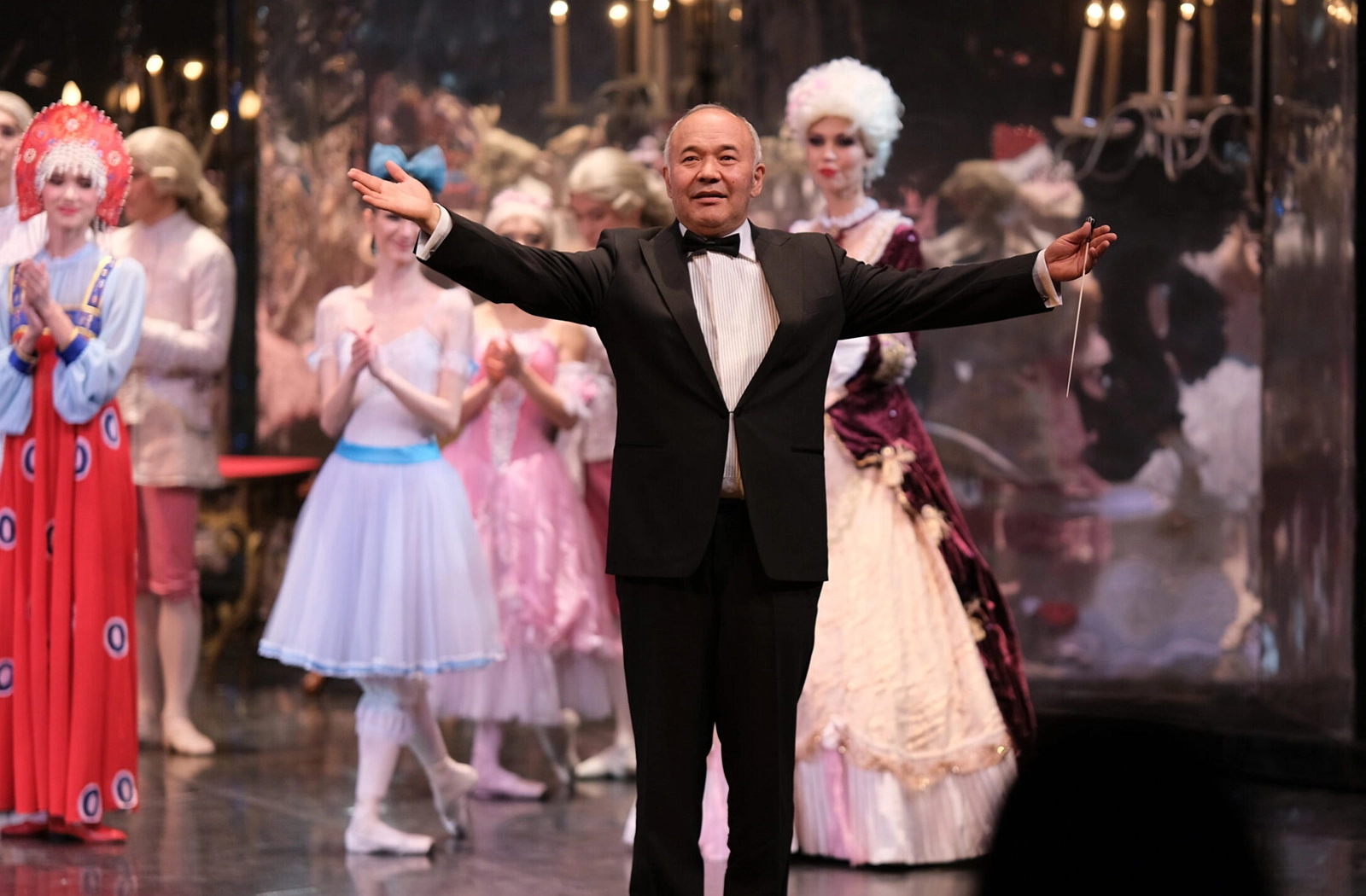
A correspondent of the media portal Caravan.kz met with maestro Mukhtar Kaldayakov to speak about his career as a conductor, his personal life, and music.
Caravan.kz Reference
Mukhtar Shamshiyevich Kaldayakov is a Kazakhstani musician, violinist, and conductor of the Abay Kazakh National Opera and Ballet Theatre. He is the son of the outstanding Kazakhstani composer Shamshi Kaldayakov. A scholarship recipient of the Bolashak state programme, he studied in the United States from 1996 to 1998. He is the founder and head of the Shámshi Álemi public foundation.
“I Felt Like a Member of Queen”
— Mukhtar Shamshiyevich, you were first trained as a violinist and later as a conductor. You have worked in the same place — the opera and ballet theatre in Almaty — for almost thirty years. How did you decide to become a conductor?
— Once, when I was studying at the Kulyash Baiseitova Music School, I was either in the tenth or eleventh grade, something happened that I remember very vividly. Our school symphony orchestra, where I played the violin, was waiting for the conductor Yuri Efimovich Dorokhovsky, who for some reason was running a little late. We were all on stage, the choir was there too, and we were supposed to rehearse for a reporting concert. We had to perform Dunayevsky’s song “Letite, golubi.” We waited five minutes, then ten, and people were already starting to murmur impatiently… I said to the others, “Let’s not make noise, let’s tune up.” Someone answered me, “Let’s not waste time, you start!” I stood up, tuned the orchestra, and began conducting. No one had ever taught me to do it. I had simply watched how it all happened during lessons. And then I started, and the song began to sound. I clearly remember that feeling of celebration! It is one thing to play the violin, and quite another to stand at the conductor’s podium with an orchestra, choir, and soloists in front of you. It touched me very deeply. It can be compared to not knowing how to swim, then suddenly jumping into the water — and swimming! You remember something like that for the rest of your life (laughs).
— After the Baiseitova School, you entered the Kurmangazy Conservatory, from where you were unexpectedly drafted into the army…
— Why unexpectedly? It was expected. After the first year, we were all called up; there were military operations in Afghanistan, soldiers were needed, and it was our duty. I ended up in the Far East. Those were two unforgettable years of my life. Unique, incredibly beautiful places. And the age was wonderful — 19! I even want to write a small memoir about my army service (smiles).
At first, I was in the music platoon in Vladivostok, where I spent two months. Teachers from one of the schools asked us to help hold a dance evening for high school students. And I was a classical musician, I played Bach, Mozart, Beethoven — I was a violinist. Of course, I had studied piano, but it was my second instrument. The musicians in my military unit needed a keyboard player, so I had to sit down at an electric piano! (laughs). But I did not know the popular repertoire! I had to play Yuri Antonov and songs by other Soviet composers. So I had to improvise on the piano as I went along. What an evening it was! I was jamming with everyone, the place was in full swing! Everyone was dressed up for the evening, the girls had done their hair. The schoolchildren, who were two or three years younger than us, were dancing with such dedication! And the hall was so crowded, packed like sardines in a barrel. An ordinary Russian town, a suburb of Vladivostok. And what happened when we came on stage! They greeted us with such screams and cheers as if Queen had arrived! (laughs) I do not remember ever receiving such a response from an audience in my entire life. It was very pleasant, while being in the army, to get a little taste of civilian life. And our guys performed the programme so well — we had a drummer, a bass guitarist, and singers. I had a feeling of a new place to live, a new happiness!
But later there was a fight in our music platoon between senior comrades, and the authorities temporarily disbanded it. We were all sent to different places. I was taken all the way to the coast of the Sea of Japan, to the most beautiful part of the Far East, to a small military unit. Looking back on that period of my life, I think it was great luck for me.
A Conductor Is a Person on a Special Mission
— Mukhtar Shamshiyevich, do you still get goosebumps from music, from the feeling of being at the conductor’s podium, from artists performing on stage?
— Quite recently, at the end of May, I conducted Swan Lake in Almaty for two days. Wonderful artists came to us — soloists of the Bolshoi Theatre, Eleonora Sevenard and Denis Rodkin. As the conductor, I came to their rehearsal on the eve of the performance and saw what divine beauty they had brought with them! I fell in love with this production all over again! They immersed me so deeply in their interpretation; I saw their grace, their beauty, their performance… The way Denis took Eleonora by the hand, the way he lifted her… It was as if, concentrated in them, I saw the entire two-hundred-year school and culture of the Bolshoi Theatre, like an astronaut seeing our Earth from space. I was filled with that divine beauty of culture, which they brought not through words but through their very presence, through the spirit they conveyed. As for goosebumps, yes, that sometimes happens (laughs). There is a healthy attitude toward one’s work. It is a way of life within the profession. When you come out to the orchestra, you feel like a person entrusted with a special mission. For example, I always go to bed no later than 11 p.m. Sometimes friends invite me over and ask me to stay longer in the evening, to talk, but I know that I cannot allow myself to do that, because I will have a performance or a morning rehearsal. You understand that the people who fill the hall do not see you, but a great deal depends on the state you are in — whether you are ready for work, whether you have slept enough, whether you are in the right mood. The artists and musicians have come, and they will do their work firmly and professionally. But you have to give them the tempo, coordinate them. And you feel that at that moment you are “living” this performance.
And it is always a live performance. There is a moment of uniqueness, like handwriting, like a fingerprint. A performance is created like a dish in a restaurant. At that very hour, especially for the guest. And you savour it!
— You conduct such masterpieces of world ballet as The Nutcracker and Swan Lake. Which work is your favourite?
— I love all the performances in which I have taken part. I have about twelve ballets and about six operas in my repertoire. The Sleeping Beauty, Giselle, The Fountain of Bakhchisarai, Spartacus. The operas Madama Butterfly, Rigoletto, La Bohème. Perhaps Puccini’s operas are my favourites. When you work on a particular production, you compare how your colleagues and musicians from other countries work on it, you listen to how they do it, you understand which particular moments sounded better, and you live with the desire to gather all those best moments and create your own unique performance.
— After the performance is over, conductors come out on stage together with the artists to bow to the audience.
— We did not use to come out before, but now we do. It still feels unusual to me. The soloists bow, then the ballerina comes out, invites you, thanks you, you come out, bow, point to the orchestra, and thank everyone. I observed how other conductors do this and realised that it gives more positive emotion from all the work that has been done. In this way, we express our respect for the hall and thank the audience for receiving us so warmly.
— In this way, you see your audience. What is its portrait today?
— In our theatre, the audience is grateful, joyful, and kind. I love our audience very much! I saw audiences at the Metropolitan Opera; for two years I attended their performances in New York. But there, the audience is mostly older — people over 60 or 70. They are very wealthy and accomplished people. Our audience is much younger.
— Do you get very tired when conducting an orchestra? How do you recover after performances, and how do you like to rest?
— I would like to answer you with a joke by our maestro Renat Salavatov. When he was asked whether conducting was difficult, he replied: “It’s the easiest thing in the world! You just move your hands like this, and the musicians play everything themselves!” (laughs). When you love something, you do not think about how much you will be paid for it or how tired you become. If everything goes according to plan, the work comes easily and there is no feeling of fatigue. Yes, there is physical exertion, but what matters more is what you feel in that moment. You draw strength and inspiration from it. It is interaction between people, one impulse, one wave. As if you are sailing on the same ship, and the wave picks you up and carries you along, uniting the performance. As for rest, I like nature, silence, the countryside. To take some boards, saw them, hammer in nails. In summer, I like swimming and going to Issyk-Kul with my family.
“Technology Replicates the Primitive”
— You lived and studied in the United States for two years as a Bolashak scholarship recipient. What do you remember from that period of your life?
— I studied there at an English language institute, attended lectures, took exams, and in the evenings often went to performances at the Metropolitan Opera. What could be better than going to a legendary theatre eight times a month? (laughs). Pavarotti sang in Turandot — I went to see it several times. Domingo sang — I listened. I was even lucky enough to attend performances where Domingo conducted! He was just beginning his career as a conductor then. I studied at evening Juilliard (one of the most prestigious performing arts schools in the world, located in New York. — Author), and my professor was the famous American conductor of Italian origin Vincent La Selva. He was the founder and director of the New York Grand Opera in Central Park, where they gave free concerts for music lovers. My music school had been mainly Russian-German, but when I entered Vincent La Selva’s class, I saw the Italian vocal school, which is different and has its own traditions. I am very grateful to the Bolashak programme and to the people who supervised me for the valuable knowledge I gained in the United States. Among my fellow students there were many interesting, educated people. I was thirty at the time, and I was one of the oldest among the students (laughs).
— Do you listen to contemporary music? If so, what genre do you prefer?
— I like light party music, film music, disco. We all loved the disco groups of the eighties: ABBA, Boney M, Arabesque. Now I listen to Paul Mauriat, Karel Gott, Soviet pop artists, and our Kazakhstani stars — Roza Rymbayeva, Dos Mukasan, A-Studio. I like certain pieces by The Beatles, Queen, and Paul McCartney.
— And what kind of music do you categorically reject?
— I cannot listen to heavy metal. For me, these are heavy, harsh, meaningless sounds. In my view, they are aggressive and primitive. At the conservatory we had a very good teacher of foreign music, Lidia Goncharova. She used to tell our class in lectures: “Young people, listen to the music of different composers, but please do not listen to contemporary pop music. Because if you let it into yourself, it will give you nothing, and you will not have time to go through our study material, which contains so much beautiful music. You will live this period of your life meaninglessly. And you came to the conservatory to study, to hear precious music that is hidden from you and that I am teaching you.” Now, at sixty, I find her advice correct; it is advice for life. Such performers have appeared on stage now that if she heard them, I can imagine her reaction (laughs). Perhaps there would even be a musicological definition for all of it. But we did not arrive at such music as an entire musical society. There are many cultured, educated young musicians and artists. Young people are wonderful! And the state helps them, supports them, gives them knowledge, if only they continue to develop. For me, the music that now, as people say, “comes from everywhere” — these are not artists, not vocalists, not lyricists, not arrangers; it is some kind of assemblage. You know, it is like food: tasteless, harmful, heavy, and too much of it! And if you eat all of that, you will have neither the time nor the money to recover from it! This music dulls the mind so much! As a musician, I often notice and hear huge fragments, episodes taken from classical music in variety and popular music… Our society has not become primitive, but modern technologies help replicate what is primitive and tasteless. And all of this reaches people quickly because there are technologies and the internet.
— If your father were alive, how would he regard contemporary Kazakh and Kazakhstani music?
— My father listened to everything connected with our national culture, delved into it, and for some reason commented very little. Because he himself came out of that culture, grew up in it, absorbed it all. When he was little, he sang well, but later damaged his voice and began writing music. Music always lived within him. That is why he never scolded anyone or tried to remake anyone. Even in human relationships, he would look at everyone silently, without judgment, as if studying them, engaged in a kind of quiet contemplation… He lived his own life, developed creatively, he was a “song factory,” a great melodist. And he never told anyone what to do, how to live, or how to create.
A Family Where Music Always Sounds
— Mukhtar Shamshiyevich, you are a violinist. Do you still pick up the instrument?
— The violin is a separate part of life. I received my diploma as a violinist in 1990. It is my instrument, it is part of me, and I am part of this instrument. I can go home now, pick up the violin, and play for an hour. Sometimes I perform by invitation at private events. We have a string quartet, and we also play in a larger ensemble. I see the happy faces of people who listen to our music, and that makes me happy too. I have also sent my children to study music. My daughter graduated from the Baiseitova School as a violinist and went on to study musicology. My son is graduating from the Baiseitova School this year. My youngest son is also studying violin.
— In one interview, you once said that by sending your children into music, you were condemning them to a not very wealthy life.
— At certain periods of life, a musician is in demand. At other times, one has to survive differently, for example, by giving music lessons. When you send a child to the first grade of a music school, you are not wasting time. I am giving my children the opportunity to receive a musical education in due time. If they suddenly decide to follow this profession, they will succeed in it.
— When I was preparing for the interview, I could not find information that you are an Honoured or People’s Artist of the Republic of Kazakhstan, despite having worked at the opera and ballet theatre for almost thirty years. Why did that happen?
— Of course, every person is pleased when their work is duly appreciated. Recently, I was awarded the title of Honoured Art Worker of the Eurasian Cultural Foundation. I focus on my work in the theatre, on creativity, and on the work of the foundation named after my father, Shamshi Kaldayakov. I am grateful to the theatre and to my colleagues for the opportunity to create, to apply the knowledge I received earlier, and to develop. Since 2000, I have been writing my own music; I have written about 12 songs.
— Your father was awarded the title of People’s Artist of the Republic of Kazakhstan shortly before his death, although all of Kazakhstan sang his songs — they were truly folk songs, loved by everyone.
— He never asked anything for himself. When my father was younger and people asked him why he still had no title, he would answer: “There are people older than me. Good musicians and artists — let them receive the titles of People’s Artists; it is still too early for me.” When my father was here, in the Council of Ministers Hospital, he was gravely ill for four months; he was 61 years old. His friend, Academician Mukhtar Aliyev, went and secured that title for him. Later, Mukhtar Aliyevich appealed to the mayor of Almaty with a request to name one of the city’s streets after Shamshi Kaldayakov.
— Your mother, Zhamilya Kaldayakova, chose the path of a composer’s wife. They say it was she who organised the entire household and “conducted” the upbringing of the children while her husband wrote music and was often away on business trips.
— That is absolutely true. I am grateful to my father for guiding us in music, and to my mother for making sure we practised our instruments a lot. I wish her health, many years of life, and may we live under her care for a long time yet! My mother devoted her whole life to the musical education of my brother and me. During the Great Patriotic War, as a teenager, she worked the night shift at one of the bread factories in Alma-Ata, unloading finished products. When she grew older, she would happily go with her peers to dances at our opera theatre. It seems to me that my father sensed in her organisational talent, devotion, a great love for music, and a skill for survival. My mother inspired not only my brother and me to study music, but also her grandchildren. I only recently learned that our grandmother paid my daughter Alina 200 tenge to practise the violin at home (laughs). Children are children: they want to go out, run around outside, and cannot always be disciplined, and our grandmother understood that and encouraged her in this way. My daughter saved 20,000 tenge and one day came to my wife asking her to exchange it for larger banknotes (laughs). But seriously, only time will tell whether my children will pursue music, write works of their own, and perhaps perform the works of their grandfather.